Right Knee Pain ICD-10 Code Explained: A Guide for Providers
September 14, 2026
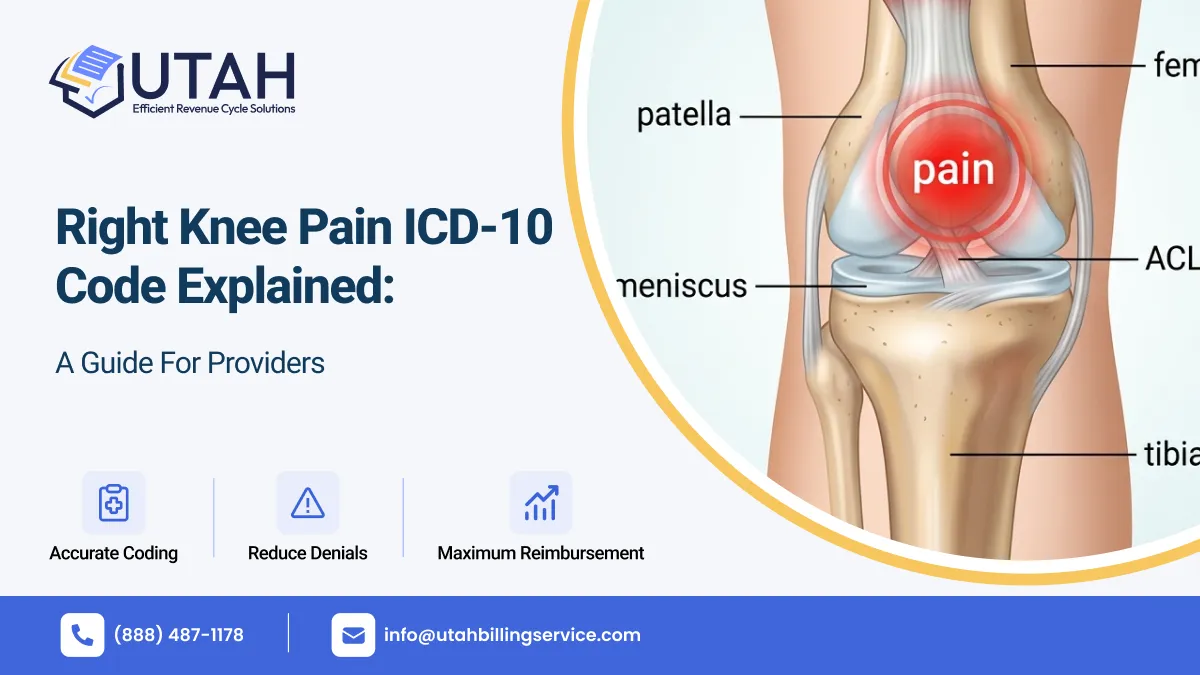
Right knee pain is a common reason for physician visits, orthopedic evaluations, imaging, physical therapy, and follow-up care. From a clinical perspective, documenting “right knee pain” may seem straightforward. From a coding and billing perspective, however, the correct diagnosis code depends on what the provider actually documented, whether an underlying condition has been established, whether the problem resulted from an injury, and how specific the documentation is.
Using the wrong Right Knee Pain ICD-10 Code can create more than a coding inconvenience. An unsupported diagnosis can contribute to claim denials, medical necessity edits, incorrect reimbursement, undercoding, overcoding, delayed payment, documentation queries, and audit exposure. The diagnosis reported on the claim should accurately represent the provider’s documented assessment and the reason the service was performed.
This guide explains the primary ICD-10-CM code for right knee pain, important alternatives when a specific knee disorder is documented, commonly associated CPT/HCPCS services, documentation requirements, billing considerations, and practical coding examples. It also explains why coders should not automatically replace a documented symptom with a suspected condition based only on imaging, examination findings, or clinical inference.
The ICD-10-CM code for pain in the right knee is M25.561.
M25.561 — Pain in right knee
This is the appropriate diagnosis code when the provider documents right knee pain and no more definitive underlying diagnosis has been established or documented for the encounter.
The important point is that M25.561 describes the symptom, not the cause of the pain. If the provider documents a specific condition such as primary osteoarthritis of the right knee, a current meniscal tear, a knee effusion, or another established disorder, the more specific diagnosis may be appropriate instead of—or in some circumstances in addition to—the pain code, depending on the coding circumstances and official guidelines.
For example:
Therefore, the presence of knee pain does not automatically mean M25.561 should be reported for every knee-related encounter.
A common coding mistake is to see the words “right knee pain” in the chief complaint and immediately assign M25.561 without reviewing the provider’s final assessment.
The chief complaint is not necessarily the final diagnosis.
Consider this example:
Chief complaint: Right knee pain
Assessment: Primary osteoarthritis of the right knee
In this situation, the provider has established a specific diagnosis. The coding decision should therefore be based on the documented diagnosis and applicable ICD-10-CM rules rather than simply coding the symptom from the chief complaint.
Conversely if the provider evaluates the patient for knee pain but does not find a clear underlying condition then the symptom code, for right knee pain may still be correct.
The difference is important because diagnosis coding supports the necessity of the services that are billed. A diagnosis should not be changed just because an X‑ray an MRI, an examination or any other information looks like it points to a particular disorder. Right knee pain should remain coded as a symptom unless the provider has a diagnosis. Diagnosis coding should not be upgraded merely because imaging or examination suggests a disorder.
Coding professionals should pay attention to the date of service when selecting an ICD-10-CM diagnosis code.
As of September 14, 2026, the applicable calendar is:
| Date of Service | Applicable ICD-10-CM Version |
|---|---|
| Through September 30, 2026 | FY 2026 ICD-10-CM |
| October 1, 2026–September 30, 2027 | FY 2027 ICD-10-CM |
CMS states that the FY 2027 ICD-10-CM files are applicable to patient encounters from October 1, 2026 through September 30, 2027. CMS also publishes the official ICD-10-CM coding guidelines for the applicable fiscal year.
This distinction becomes particularly important when a claim is submitted, corrected, appealed, or audited after a code-set change. The applicable code is generally determined by the rules governing the date of service or encounter—not simply the date the claim happens to be submitted.
For inpatient reporting, additional rules can apply based on the discharge date and setting. Institutional coders should therefore use the applicable inpatient coding rules rather than applying outpatient assumptions to every encounter.
The following table summarizes commonly encountered right-knee diagnosis codes. It is not an exhaustive substitute for the ICD-10-CM codebook.
| Condition or Scenario | ICD-10-CM Code | Official/Standard Description |
|---|---|---|
| Right knee pain | M25.561 | Pain in right knee |
| Left knee pain | M25.562 | Pain in left knee |
| Unspecified knee pain | M25.569 | Pain in unspecified knee |
| Right knee effusion | M25.461 | Effusion, right knee |
| Right knee stiffness | M25.661 | Stiffness of right knee, not elsewhere classified |
| Other specified right knee joint disorder | M25.861 | Other specified joint disorders, right knee |
| Unspecified knee joint disorder | M25.869 | Other specified joint disorders, unspecified knee |
| Primary osteoarthritis, right knee | M17.11 | Unilateral primary osteoarthritis, right knee |
| Post-traumatic osteoarthritis, right knee | M17.31 | Unilateral post-traumatic osteoarthritis, right knee |
| Other unilateral secondary osteoarthritis, right knee | M17.5 | Other unilateral secondary osteoarthritis of knee |
| Osteoarthritis of knee, unspecified | M17.9 | Osteoarthritis of knee, unspecified |
| Hemarthrosis, right knee | M25.061 | Hemarthrosis, right knee |
| Right knee meniscal disorder | Various M23.- or S83.- codes | Selection depends on the documented meniscal condition and circumstances |
| Current medial meniscus tear, right knee | Various S83.- codes | Exact code depends on tear type and encounter |
| Current lateral meniscus tear, right knee | Various S83.- codes | Exact code depends on tear type and encounter |
| ACL injury, right knee | Various S83.- codes | Exact code depends on ligament and encounter |
| Patellar tendon injury | Various S86.- codes | Exact code depends on injury and encounter |
| Fracture involving right knee structures | Various S72.-, S82.- or other codes | Depends on exact bone, fracture pattern, and encounter |
CMS’s current code listings identify M25.561 as “Pain in right knee,” M25.461 as “Effusion, right knee,” and M25.661 as “Stiffness of right knee, not elsewhere classified.” The same listings identify M17.11 as unilateral primary osteoarthritis of the right knee.
The M25.56- family is used for knee pain. Other ICD-10-CM categories capture specific diseases, disorders, and injuries.
This means a provider documenting:
“Right knee pain”
is not equivalent to documenting:
“Primary osteoarthritis of right knee.”
Likewise, “right knee pain after a twisting injury” does not automatically establish a meniscal tear. If the provider has not diagnosed the tear, a coder should not independently assign a tear diagnosis simply because an MRI or physical examination appears consistent with one.
The first step is to identify what the provider actually diagnosed.
Review the complete encounter documentation rather than relying only on the chief complaint or reason for scheduling.
Relevant documentation may include:
The assessment and plan are particularly important because they often clarify whether the provider considers the problem to be a symptom or a specific disease or injury.
If the provider documents only right knee pain, M25.561 may be appropriate.
If the provider establishes a specific condition causing the pain, the more specific condition code may be appropriate.
For example:
Documentation:
“Right knee pain. X-ray obtained. Etiology undetermined. Follow up after MRI.”
A symptom code may be appropriate when no definitive diagnosis has been established.
Documentation:
“Primary osteoarthritis of right knee with chronic pain.”
The osteoarthritis diagnosis is more specific than simply reporting knee pain.
The exact sequencing and whether an additional symptom code is separately reportable depend on the applicable coding rules and the circumstances of the encounter.
Laterality is one of the most important details in musculoskeletal coding.
Compare:
If the provider clearly documents the right knee, an unspecified-knee code generally should not be selected simply because it is easier to locate.
Laterality should be consistent throughout the medical record, procedure documentation, imaging order, and claim.
A mismatch such as:
should trigger a documentation review rather than an assumption by the coder.
Knee pain can result from numerous conditions, including:
The provider’s diagnosis determines which ICD-10-CM category should be considered.
For example, CMS’s current code listings include M17.11 for unilateral primary osteoarthritis of the right knee and M25.461 for effusion of the right knee.
Injury coding is more complicated than symptom coding.
A current injury involving the knee may require:
For example, meniscal injury codes in the S83 category can distinguish different types of meniscal tears and include encounter-specific characters.
A current meniscal tear should not simply be coded as M25.561 because the patient also has pain. If the provider has diagnosed the tear, the injury code may be more appropriate.
Conversely, a coder should not infer a meniscal tear from pain alone.
The ICD-10-CM code set contains different categories for current injuries and certain chronic or old meniscal derangements.
For example, CMS materials include codes for meniscal derangements due to old tear or injury, including right-knee-specific codes such as M23.206 and more anatomically specific M23.- codes.
The record should make clear whether the provider is treating:
This distinction can materially affect code selection.
Finding a code through an electronic search tool is not the end of the coding process.
Coders should verify the code in the applicable ICD-10-CM Tabular List and review:
The Official Guidelines explain that the ICD-10-CM classification conventions and Tabular List instructions take precedence over general guidance.
Diagnosis selection and medical necessity are closely connected but are not the same thing.
For example, a provider may bill:
The diagnosis code submitted should support the clinical reason for the service when required by the payer’s coverage policy.
A diagnosis code should never be selected simply because it is believed to produce a higher reimbursement.
There is no single CPT code for “right knee pain.”
ICD-10-CM codes communicate the diagnosis or reason for the service, while CPT and HCPCS codes generally describe the service, procedure, or supply provided.
The appropriate CPT code therefore depends on what the provider actually performed.
For office and other outpatient E/M services, commonly encountered codes include:
| CPT Code | Common Use |
|---|---|
| 99202 | New patient office/outpatient E/M, lower level |
| 99203 | New patient office/outpatient E/M, low level MDM |
| 99204 | New patient office/outpatient E/M, moderate level MDM |
| 99205 | New patient office/outpatient E/M, high level MDM |
| 99211 | Established patient office/outpatient E/M, minimal service when applicable |
| 99212 | Established patient office/outpatient E/M, straightforward MDM |
| 99213 | Established patient office/outpatient E/M, low-level MDM |
| 99214 | Established patient office/outpatient E/M, moderate-level MDM |
| 99215 | Established patient office/outpatient E/M, high-level MDM |
The final E/M level must be supported by the applicable CPT and payer rules. It should not be selected simply because a patient has a complicated diagnosis.
CMS’s Medicare physician data identifies commonly billed office E/M codes such as 99203, 99204, 99213, and 99215 in orthopedic practice.
When imaging is medically necessary and performed, commonly encountered knee radiography codes include:
| CPT Code | Service |
|---|---|
| 73560 | Knee X-ray, 1–2 views |
| 73562 | Knee X-ray, 3 views |
| 73564 | Knee X-ray, 4 or more views |
| 73565 | Bilateral knee X-ray, standing views, when applicable |
CMS Medicare physician data identifies 73560, 73562, and 73564 as knee radiography services.
The number of views documented should support the code billed. A practice should not routinely select a four-or-more-view code when the documentation supports only one or two views.
A commonly encountered procedure is:
20610 — aspiration and/or injection of a large joint or bursa, without ultrasound guidance
For an ultrasound-guided large-joint aspiration/injection, the applicable code may be:
20611 — aspiration and/or injection of a large joint or bursa, with ultrasound guidance, including permanent recording and reporting
CMS physician data identifies 20610 and 20611 as commonly performed services in orthopedic practices.
The diagnosis supporting the procedure should reflect the condition being treated. For example, documentation of a right knee effusion may support an aspiration when the procedure and medical necessity requirements are satisfied.
The presence of right knee pain alone does not automatically establish coverage for an injection or aspiration. Payer policy, documentation, drug billing, frequency limitations, and medical necessity requirements must also be considered.
When right knee pain is being treated through physical therapy, services may include codes such as:
The specific CPT selection depends on the service actually performed, documentation, time requirements, and applicable payer rules.
A diagnosis such as M25.561 may be relevant when right knee pain is the documented reason for therapy, but the therapist or provider should report the diagnosis supported by the applicable documentation and coding rules.
M25.561 is only one member of a much larger group of diagnoses that may be encountered during evaluation of knee complaints.
A very common specific diagnosis is:
M17.11 — Unilateral primary osteoarthritis, right knee
Other osteoarthritis categories may apply when the provider documents:
The distinction matters because these diagnoses do not describe the same clinical condition.
For example, a documented history of trauma does not automatically mean the current arthritis should be classified as post-traumatic. The provider’s diagnosis should establish the relationship when that distinction is required.
M25.461 — Effusion, right knee
This code may be relevant when the provider diagnoses joint effusion rather than simply documenting pain.
An effusion may coexist with another condition. Whether both diagnoses should be reported depends on the documentation and applicable coding rules.
M25.661 — Stiffness of right knee, not elsewhere classified
This can be relevant when stiffness is the documented problem being evaluated or treated.
Again, the presence of stiffness does not necessarily mean that it should replace a documented underlying condition.
Meniscal diagnoses can be much more specific than knee pain.
The ICD-10-CM classification contains M23.- codes for various meniscal derangements and S83.- codes for current injuries. CMS materials, for example, list right-knee-specific meniscal derangement codes and multiple types of current meniscal tears.
The provider should document the diagnosis sufficiently to distinguish the relevant condition.
Knee ligament injuries may also fall within the S83 category.
Depending on the injury, coding may require identification of:
A diagnosis such as “right knee pain after sports injury” does not automatically justify an ACL tear code unless the provider has documented that diagnosis.
Good documentation supports both clinical care and defensible billing.
For a right-knee encounter, providers should consider documenting the following:
| Documentation Element | Why It Matters |
|---|---|
| Right vs. left knee | Supports laterality-specific coding |
| Primary reason for visit | Establishes the purpose of the encounter |
| Symptom description | Helps characterize the presenting problem |
| Duration/onset | Helps distinguish acute, chronic, or injury-related conditions |
| Mechanism of injury, when applicable | Supports injury classification |
| Specific diagnosis | Allows more specific coding when established |
| Location/structure involved | May affect diagnosis selection |
| Relevant examination findings | Supports clinical assessment |
| Imaging results | Provides clinical context but does not independently create a diagnosis for the coder |
| Assessment | Identifies the provider’s clinical conclusion |
| Treatment/plan | Supports medical necessity and management |
| Procedure performed | Supports CPT/HCPCS reporting |
| Laterality in procedure note | Helps prevent right/left claim mismatches |
| Follow-up status | Helps establish ongoing treatment or sequelae |
Documentation such as:
“Knee hurts. X-ray normal.”
may be insufficient to explain the final assessment and treatment plan.
A more useful record might state:
“Patient presents with right knee pain for six weeks without acute trauma. Examination demonstrates medial joint-line tenderness. X-rays show no acute fracture. Assessment: right knee pain of undetermined etiology. MRI ordered due to persistent symptoms despite conservative treatment.”
The exact wording will vary by clinical situation, but the second example makes the provider’s assessment and management much clearer.
The important distinction is that the coder should not turn a finding such as “medial joint-line tenderness” into a diagnosis such as meniscal tear unless the provider documents that diagnosis or applicable coding rules otherwise support it.
A clean claim generally requires the diagnosis and procedure information to tell a consistent clinical story.
For example:
Scenario: A patient presents with right knee pain. The physician evaluates the patient and orders a knee X-ray.
Potential claim structure:
The diagnosis supports why the patient was evaluated and why the imaging may have been ordered, subject to payer medical necessity rules.
Now consider a different encounter:
Scenario: The provider documents primary osteoarthritis of the right knee and performs an appropriate knee injection.
The claim may use:
The actual claim must reflect the services, products, documentation, payer policy, and coding rules applicable to that encounter.
If the provider establishes osteoarthritis, coding only “right knee pain” may reduce diagnostic specificity.
A coder should not independently convert an imaging finding into a provider diagnosis unless the applicable coding rules specifically allow it.
For example, an MRI may describe a possible meniscal tear, but the provider’s documented diagnosis and the applicable outpatient/inpatient coding rules determine how that information should be handled.
If the documentation clearly identifies the right knee, using an unspecified knee code may unnecessarily reduce specificity.
Laterality discrepancies are particularly important for procedures.
The diagnosis, procedure note, imaging report, and claim should be internally consistent.
Clinical suspicion is not automatically equivalent to a documented diagnosis.
Many injury codes require a seventh character. Selecting the base code without verifying the complete code can result in an invalid or inappropriate claim.
An ICD-10-CM code does not itself guarantee payment.
Coverage can depend on:
Documentation:
“Patient reports right knee pain for three weeks. No definitive diagnosis established. Conservative treatment recommended.”
Likely diagnosis:
M25.561 — Pain in right knee
The symptom is the documented problem because no more specific diagnosis has been established.
Documentation:
“Primary osteoarthritis of right knee. Pain and reduced mobility. Discussed conservative treatment options.”
Likely diagnosis:
M17.11 — Unilateral primary osteoarthritis, right knee
The specific disease diagnosis is more informative than coding only the symptom.
Documentation:
“Right knee effusion with swelling and discomfort. Aspiration performed.”
Potential diagnosis:
M25.461 — Effusion, right knee
An appropriate aspiration/injection CPT would then be selected based on the actual procedure performed and whether the applicable requirements are met.
Documentation:
“Current tear of medial meniscus of right knee following twisting injury. Initial active treatment provided.”
The appropriate S83.- diagnosis should be selected based on the exact documented tear and encounter circumstances rather than simply using M25.561.
Documentation:
“MRI demonstrates findings suspicious for medial meniscal tear. Provider assessment: right knee pain; diagnosis remains undetermined.”
A coder should not automatically convert the MRI wording into a definitive meniscal tear diagnosis. The applicable coding guidelines and the provider’s documented assessment must control.
A useful rule for practice is:
Use M25.561 when right knee pain is the documented condition being evaluated and no more definitive diagnosis has been established for that encounter.
Consider a symptom code when:
Consider a more specific diagnosis when:
The decision should be based on the provider’s documentation and the official coding rules—not on what the coder believes is clinically most likely.
Diagnosis coding frequently plays an important role in demonstrating why a service was medically necessary.
For example, a payer may evaluate whether the diagnosis supports:
This does not mean that a particular ICD-10 code automatically guarantees coverage.
Payers may apply their own policies and documentation requirements. Medicare coverage articles, local coverage determinations, national coverage determinations, and commercial payer policies may establish additional requirements for particular services.
Therefore, practices should verify the payer-specific medical necessity policy before assuming that M25.561 will support every service associated with right knee pain.
When a claim involving M25.561 is denied, the diagnosis code itself may not always be the underlying problem.
Review the entire claim for:
For example, an MRI denial may involve a payer’s documentation or authorization requirements rather than an error in the basic M25.561 code.
A strong denial-management process therefore reviews the clinical record, diagnosis, procedure, payer policy, authorization status, and claim edits together.
Instead of simply documenting “knee pain,” specify the side whenever clinically relevant:
Right knee pain
rather than:
Knee pain
If the clinical assessment establishes osteoarthritis, meniscal pathology, ligament injury, or another condition, document the diagnosis clearly.
Do not expect the coder to determine the final diagnosis from a radiology report or examination finding.
If an injection is performed, document:
A right-knee injection should not have documentation that identifies the left knee.
For services such as advanced imaging, injections, procedures, and surgery, verify payer-specific requirements before treatment whenever feasible.
The Right Knee Pain ICD-10 Code most commonly used when the documented condition is simply pain in the right knee is M25.561. However, right knee pain is a symptom, and it should not automatically replace a more specific provider-documented diagnosis such as right knee osteoarthritis, effusion, meniscal injury, ligament injury, or another knee disorder.
Accurate coding requires more than finding a code that contains the words “right knee.” Providers and coding professionals should verify the documented diagnosis, laterality, clinical circumstances, injury status, applicable instructional notes, date-of-service code set, and payer requirements before submitting the claim.
For billing purposes, the ICD-10-CM diagnosis must also make sense in relation to the CPT or HCPCS service being reported. A knee X-ray, office visit, injection, aspiration, physical therapy service, MRI, or surgical procedure may each require different documentation and medical necessity considerations.
The safest approach is to code what the provider documented and what the applicable coding rules support, rather than coding from assumptions. Using the most specific supported diagnosis can reduce avoidable denials, improve claim accuracy, support medical necessity, and create a stronger record for reimbursement and audit review.
The commonly used ICD-10-CM code for pain in the right knee is M25.561.
Yes. M25.561 is an ICD-10-CM diagnosis code describing pain in the right knee.
The ICD-10-CM code is M25.562 — Pain in left knee.
M25.569 — Pain in unspecified knee is used when the documentation does not establish the side.
For unilateral primary osteoarthritis of the right knee, the code is M17.11.
The code is M25.461 — Effusion, right knee.
It may be reported when right knee pain is the documented diagnosis/reason for the encounter and the imaging is medically necessary. The specific radiology CPT depends on the number of views performed and documented, and payer coverage requirements still apply.
The CPT code depends on the procedure performed. 20610 is commonly used for aspiration and/or injection of a large joint or bursa without ultrasound guidance, while 20611 applies when the applicable ultrasound-guided service is performed and documented.
The diagnosis code does not determine the CPT code by itself.
Not automatically. The coder should follow the applicable ICD-10-CM coding rules and the provider’s documented diagnosis. An imaging finding should not automatically be converted into a definitive diagnosis when the provider has not established it.
It depends on the documentation and applicable coding rules. If the provider documents an underlying condition causing the pain, the underlying diagnosis may be sufficient. Whether the symptom should also be reported depends on the specific circumstances and official coding guidance.
No. An ICD-10-CM diagnosis code does not guarantee reimbursement. Payment depends on the payer’s coverage rules, medical necessity requirements, CPT/HCPCS coding, authorization, documentation, claim edits, and other applicable requirements.
Yes. ICD-10-CM codes are updated by fiscal year. For encounters through September 30, 2026, the applicable FY 2026 code set should be used. FY 2027 codes apply beginning October 1, 2026, subject to the applicable setting-specific rules.