Reclaim Up to 80% of Your Lost Revenue With These Audit Checkpoints
May 13, 2026

Healthcare practices lose heavy revenue every month without even realizing it. Some losses happen before the patient is seen. Others occur during coding, documentation, or claim submission. Many are hidden inside denied claims, underpayments, aging accounts receivable, or incorrect patient balances.
Most providers assume declining revenue is caused by low patient volume or payer reimbursement cuts. In reality, it usually comes from small operational gaps throughout the RCM.
These problems appear to be insignificant when we consider them as separate issues. Together, they silently reduce collections by 15% to 30% or even more.
At Utah Billing Service, we conduct detailed revenue cycle audits that help healthcare providers identify hidden financial leaks and recover revenue that was previously slipping away unnoticed. In many cases, optimizing front-end workflows, coding accuracy, denial management, and payment reconciliation can improve collections by up to 80–90%.
This blog explains a complete revenue audit checklist divided into three major stages of the healthcare cycle:
Each stage contains five critical checkpoints that directly impact your practice revenue.
The modern healthcare billing environment is more complicated than ever before. Insurance rules are revised all the time. Payer policies get stricter, and documentation needs keep growing.
Even highly skilled providers struggle to manage billing steps. Without a structured healthcare audit, practices often operate with blind spots.
A proper medical revenue audit helps identify:
More importantly, it provides measurable ways to increase medical practice revenue without increasing patient volume.
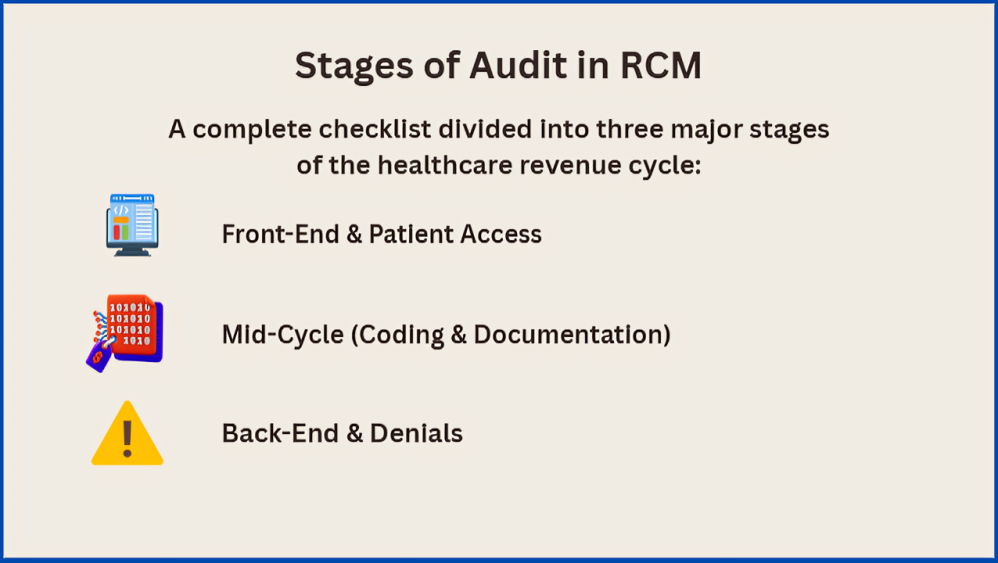
Each stage contains five critical checkpoints that directly impact your practice revenue.
Front-end operations are the foundation of the entire revenue cycle. If patient information or insurance data is incorrect at the beginning, every step afterward becomes vulnerable to denials and payment delays. Many practices underestimate how much revenue leakage begins at patient intake.
Insurance eligibility verification is one of the most important checkpoints in any revenue audit checklist. When eligibility is not verified correctly before the appointment, practices often face:
A healthcare revenue cycle audit should review insurance before every visit. Verify how staff handle inactive policies, coordination of benefits accuracy and secondary insurance. Moreover they also check real-time eligibility verification.
Many denied claims originate from outdated insurance information that could have been identified within minutes before the patient encounter. Improving verification workflows alone can significantly reduce front-end denials and improve first-pass claim acceptance rates.
Prior authorization mistakes are one of the fastest ways to lose revenue. Even medically necessary services may go unpaid if authorization requirements are missed or submitted incorrectly. A medical revenue audit should evaluate:
Common problems include:
Specialties such as cardiology, radiology, oncology, orthopedics, and behavioral health often face approval denials. Strong management directly improves payment consistency and protects high-value claims.
A single spelling mistake or incorrect date of birth can cause claim rejection. Demographic errors continue to be one of the most common yet preventable billing problems in healthcare. A revenue cycle audit should examine:
Small demographic mistakes can cause payer edits, delaying refunds for weeks. Practices should routinely audit front desk registration workflows,digital intake forms data syncing between EHR and billing software and staff training procedures
Reducing demographic errors improves clean claim rates and minimizes unnecessary rework for billing teams.
Many practices focus heavily on insurance collections while overlooking patient balances.
However, rising deductibles and coinsurance responsibilities have made patient payments a major revenue source. A healthcare revenue cycle audit should evaluate:
Practices that fail to collect balances upfront often struggle with bad debt later. Key indicators to monitor percentage of patient balances collected at check-in, average outstanding self-pay balance, patient payment delays and collection agency dependency
Improving POS collections strengthens cash flow immediately without increasing patient volume.
The NSA changed how providers manage patient billing transparency. Non-compliance can lead to fines, disputes, and unhappy patients.
A revenue audit should check:
Many practices are adjusting their operations to meet federal billing transparency rules. Clear communication with patients builds trust and reduces billing conflicts..
Read more about How Does the No Surprises Act Protect You?
The second stage determines whether services are documented, coded, and billed correctly.
Even if front-end processes are flawless, poor documentation or coding mistakes can still lead to denials and compliance risks.
This phase of the healthcare revenue cycle audit focuses heavily on clinical accuracy and expenses recovery.
Payers do not reimburse based only on performed services. They reimburse based on documented medical necessity. Incomplete documentation is one of the biggest contributors to denied claims.
A medical revenue audit should review:
Strong documentation protects both reimbursement and compliance. It also reduces risks associated with payer audits and recoupments.
Coding errors directly have a significant impact on overall practice revenue because even small Coding errors have a large effect on practice revenue. These include:
Errors can also increase claim refusals and trigger payer audits
A revenue cycle audit should evaluate:
Experienced providers may overlook coding opportunities. They might stick to old coding practices that don’t meet current payer requirements. This often leads to coding audits revealing issues which have a direct impact on financial return.
Modifier misuse remains one of the largest denial triggers in healthcare billing. Modifier -25 is particularly scrutinized by insurance payers because it affects reimbursement for evaluation and management services performed on the same day as procedures.
A healthcare revenue cycle audit should examine:
Improper modifier usage can trigger refund demands and audit exposure. However, avoiding modifiers entirely can also reduce legitimate revenue. The goal is accurate and compliant usage supported by strong documentation.
Charge capture failures create direct revenue leakage. If services are performed but never billed, practices lose revenue permanently.
An auditor should review:
Commonly missed charges are supplies, injections and procedures performed during follow-up visits Charge capture audits help ensure every billable service is accounted for accurately. Even small missed charges accumulate into substantial annual losses.
Charge lag refers to the time between the patient encounter and claim submission. Long charge lag cycles negatively affect cash flow and increase filing limit risks. A revenue audit checklist should measure:
Reducing charge lag creates faster reimbursement cycles and improves operational efficiency.
The final stage of the RCM determines whether the practice actually receives full reimbursement. This is where many healthcare organizations discover hidden revenue leakage.
Denied claims, underpayments, unresolved balances, and aging accounts receivable can quietly drain profitability month after month.
Clean claim rate measures how many claims are accepted on the first submission without edits or rejections. A low claim rate signals operational inefficiencies throughout the process. A healthcare revenue cycle audit should evaluate:
High-performing billing operations usually have strong clean claim performance. It happens because they review claims carefully before submission.
Improving clean claim rates reduces rework, accelerates reimbursement, and lowers administrative costs.
Denials are not isolated events. If they happen often, they usually point to bigger operational issues. A medical revenue audit should analyze:
Many practices only focus on appealing denials instead of identifying root causes. Understanding denial patterns is one of the most effective ways to increase medical practice revenue.
A/R aging reveals how long claims remain unpaid. Old balances reduce cash flow predictability and increase collection risks.
An auditor should evaluate:
Healthy A/R management keeps revenue moving efficiently through the practice.
Many providers assume paid claims are paid correctly. Unfortunately, insurance underpayments are extremely common. Without payment reconciliation audits, practices may lose substantial revenue unnoticed.
A healthcare auditor should compare:
Underpayments may occur due to incorrect payer calculations, bundling errors and contract misconfigurations. Regular underpayment reconciliation ensures providers receive the full reimbursement they earned.
Confusing or inaccurate patient statements create payment delays and frustration. Patients are far less likely to pay balances they do not understand.
A revenue audit checklist should examine:
Clear patient statements improve collections while enhancing patient trust and satisfaction.
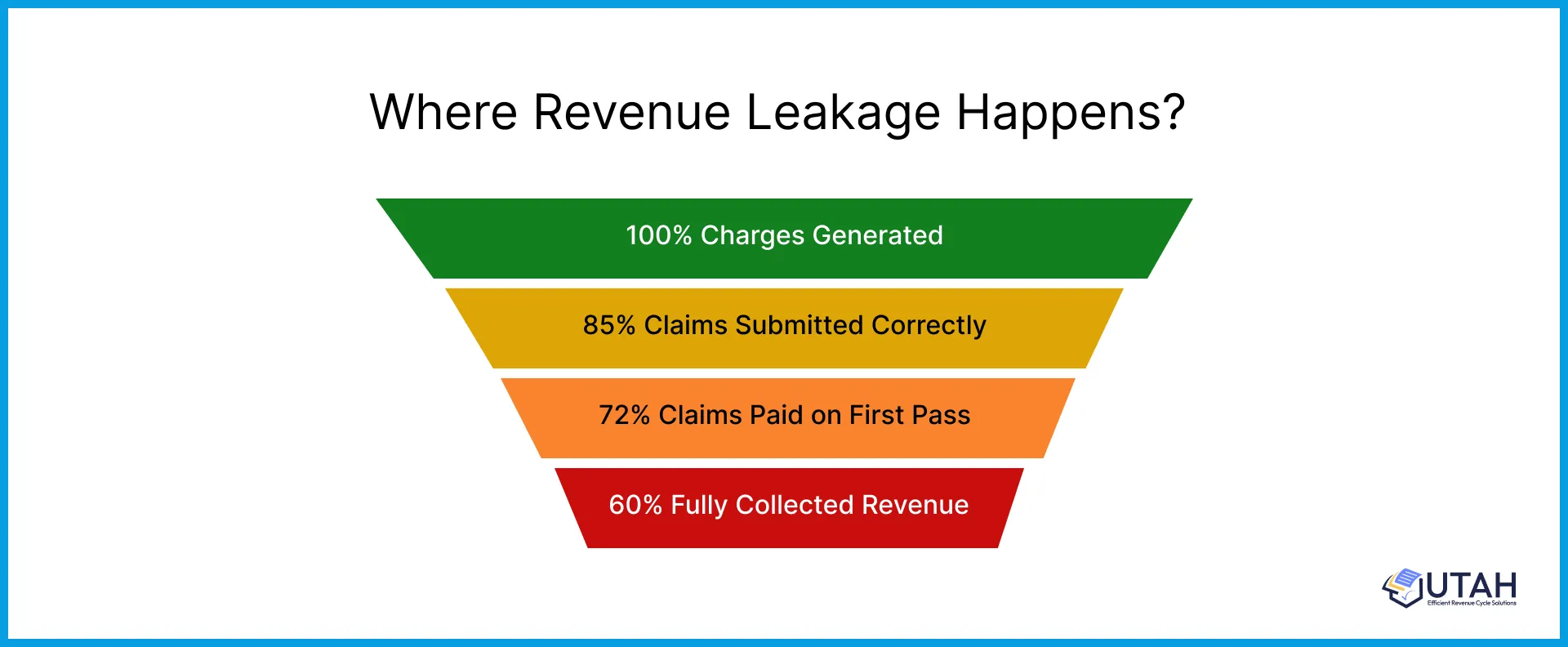
Many providers think seeing more patients is the reason for growth. But in reality, optimizing the existing RCM often generates compensation amounts with less operational stress.
Most importantly, audits uncover revenue that practices already earned but failed to collect properly.
Many providers wait until cash flow problems become severe before investigating RCM issues. However, early warning signs usually appear long before major financial disruption occurs. You may need a medical revenue audit if your practice experiences:
Even financially stable practices benefit from routine healthcare revenue cycle audits because payer requirements and billing regulations change continuously.
Revenue leakage rarely comes from one major mistake. It usually develops through dozens of small inefficiencies such as,
That is why a complete revenue audit is very important. When practices regularly review all operations, they gain visibility to exact areas that lower profitability.
If your practice is struggling with denials, delayed reimbursements, underpayments, or inconsistent collections, now is the time to evaluate them. At Utah Billing Service, we help healthcare providers to identify operational weaknesses in the entire RCM process.
Our team analyzes front-end workflows, coding patterns, denial trends, underpayments, and reimbursement gaps to help practices recover lost revenue and improve financial performance sustainably.
An audit checklist may be a document or tool that facilitates an audit cycle which contains documented information such as the scope of the audit, evidence collection, audit tests and methods, analysis of the results as well as the conclusion and follow up actions such as corrective and preventive actions.
Checklists are used both to ensure that safety-critical system preparations are carried out completely and in the correct order
5 Pillars of Effective Audit: Assess, Understand, Document, Inspect, Test