ICD-10 Codes for Interventional Cardiology: A Complete Guide
September 8, 2026
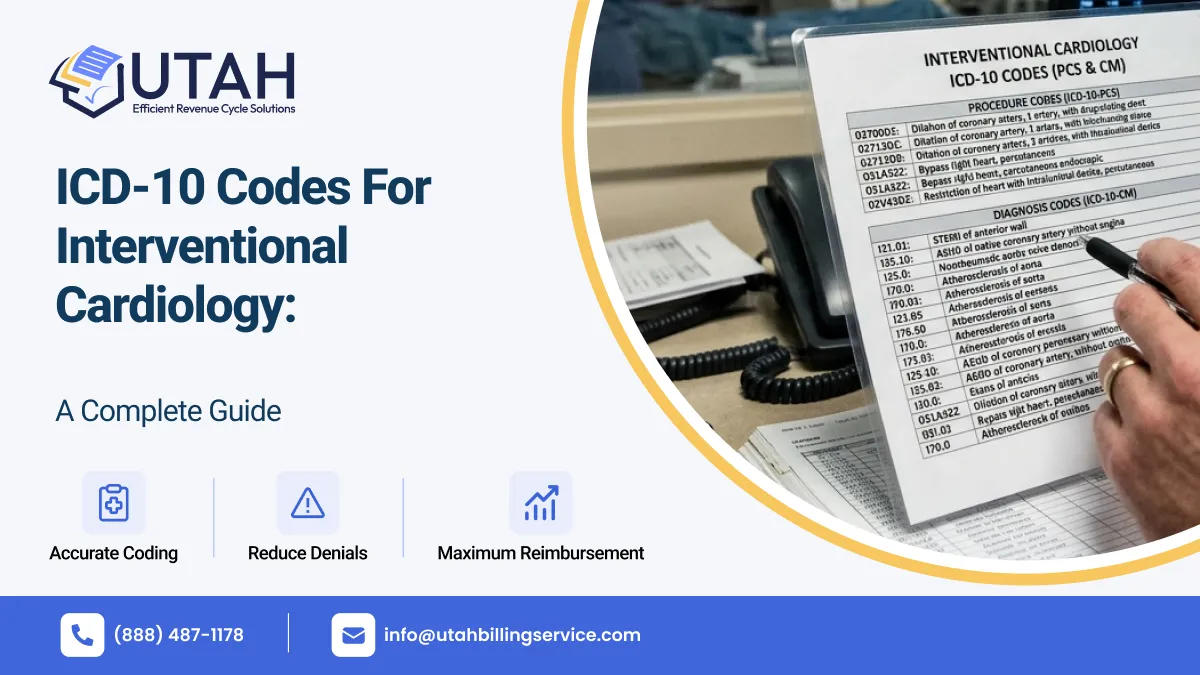
Accurate diagnosis coding is an essential part of interventional cardiology billing. Procedures such as coronary angiography, cardiac catheterization, percutaneous coronary intervention (PCI), balloon angioplasty, and coronary stent placement require documentation that clearly describes the patient’s condition and supports the medical necessity of the services provided.
In interventional cardiology, coding errors can contribute to claim denials, payment delays, inaccurate reporting, and compliance concerns. Selecting the appropriate ICD-10-CM diagnosis code requires more than identifying a cardiovascular condition. The code must be supported by the provider’s documentation and selected according to the applicable ICD-10-CM code set, official coding guidelines, and payer requirements.
This guide explains commonly encountered ICD-10-CM diagnosis categories in interventional cardiology, clarifies the difference between diagnosis and procedure coding, discusses documentation requirements for common coronary interventions, and highlights strategies for improving coding accuracy and reducing preventable billing problems.
ICD-10-CM is the U.S. diagnosis classification system used to report diseases, conditions, symptoms, and other reasons for healthcare encounters. The official coding guidelines emphasize that complete and accurate coding depends on complete documentation and review of the medical record.
In interventional cardiology, ICD-10-CM diagnosis codes may be used to report conditions such as:
The appropriate diagnosis depends on what the provider has established and documented for the encounter.
For example, a patient undergoing coronary angiography may have documented coronary artery disease, angina, an acute coronary syndrome, an abnormal diagnostic finding, or another clinical indication. The diagnosis reported on the claim should reflect the condition or reason for the service supported by the medical record.
The ICD-10-CM Official Guidelines state that accurate coding cannot be achieved without adequate documentation and that the record should be reviewed to determine the reason for the encounter and the conditions treated.
For interventional cardiology practices, documentation should therefore clearly communicate:
Coders should not assign a more specific diagnosis than the documentation supports.
One of the most important concepts in cardiology billing is understanding the difference between diagnosis and procedure coding.
ICD-10-CM codes describe the patient’s diagnosis, condition, symptoms, or reason for the encounter.
CPT and HCPCS codes describe the procedures, services, drugs, supplies, and other items reported on a claim.
For example, a claim for a coronary intervention may contain an ICD-10-CM diagnosis describing the patient’s documented coronary disease or acute cardiac condition, while CPT codes report the specific procedure performed.
These coding systems work together but serve different purposes.
A useful way to think about the relationship is:
Clinical condition → ICD-10-CM diagnosis coding → Procedure/service → CPT/HCPCS coding → Claim submission
The diagnosis code should not be selected simply because it makes a procedure easier to bill. It must accurately represent the patient’s documented condition or reason for the service.
The following examples represent commonly encountered cardiovascular diagnosis codes. They are not an exhaustive list, and the correct code depends on the documentation and circumstances of the encounter.
| Condition | Example ICD-10-CM code | Coding consideration |
|---|---|---|
| Atherosclerotic heart disease of native coronary artery without angina | I25.10 | Used when native coronary atherosclerotic heart disease is documented without angina pectoris. |
| Atherosclerotic heart disease of native coronary artery with angina | I25.11- | The appropriate additional characters depend on the documented type of angina. |
| Old myocardial infarction | I25.2 | Used for documented old/healed myocardial infarction rather than an acute MI. |
| Acute myocardial infarction | I21.- | Requires selection of the appropriate acute MI code based on the documented type and circumstances. |
| Angina pectoris | I20.- | Selection depends on the documented type of angina. |
| Heart failure | I50.- | Specificity may include systolic, diastolic, combined, acute, chronic, or acute-on-chronic heart failure. |
| Hypertensive heart disease | I11.- | Requires application of the applicable combination-code guidelines. |
| Peripheral vascular disease | I73.- | Selection depends on the specific documented vascular condition. |
| Cardiac arrhythmias | I47.- to I49.- | The appropriate code depends on the documented rhythm disorder. |
For example, I25.10 describes atherosclerotic heart disease of the native coronary artery without angina pectoris, while I25.2 describes old myocardial infarction.
Likewise, heart failure coding requires attention to the type and acuity documented by the provider. For example, I50.22 represents chronic systolic congestive heart failure.
A statement such as “heart disease” may not provide enough information for the most specific applicable code.
More complete documentation may identify:
The goal is not to select the most complicated code available. The goal is to select the most specific code supported by the provider’s documentation and the applicable coding rules.
One important distinction in cardiology coding is whether the encounter is inpatient or outpatient.
For outpatient services, diagnoses documented as “probable,” “suspected,” “questionable,” “rule out,” “compatible with,” “consistent with,” or similar terms indicating uncertainty are generally not coded as established diagnoses. Instead, the coder reports the condition to the highest degree of certainty for that encounter, such as documented symptoms, signs, abnormal test results, or another reason for the visit.
This is particularly important when coding diagnostic cardiovascular services.
For example, documentation stating that a patient is being evaluated for suspected coronary artery disease does not automatically justify reporting established CAD as the outpatient diagnosis. The coder must follow the applicable outpatient guidelines and report the condition or reason for the service to the appropriate level of certainty.
This rule differs from the uncertain-diagnosis rules used for certain inpatient hospital admissions, where qualifying terms such as “probable” or “suspected” may be coded differently.
Cardiac catheterization may be performed for diagnostic evaluation, hemodynamic assessment, or as part of an interventional procedure.
The diagnosis reported should explain the documented reason for the service.
Depending on the clinical circumstances, relevant documentation may include:
The diagnosis should be supported by the medical record rather than selected simply because catheterization was performed.
The procedure itself is reported separately using the applicable CPT or HCPCS coding rules.
Coronary angiography allows the physician to visualize the coronary arteries and evaluate stenosis, obstruction, or other abnormalities.
Documentation supporting the service may include:
When the encounter is outpatient, coders should not automatically convert a suspected condition into a confirmed diagnosis. If the definitive diagnosis is not established, the coding should follow the outpatient rules for reporting the highest degree of certainty.
Percutaneous coronary intervention includes therapeutic coronary procedures such as balloon angioplasty and coronary stent placement.
PCI may be performed in circumstances involving:
The ICD-10-CM diagnosis explains the patient’s condition or reason for treatment. The applicable CPT codes report the actual intervention.
Because PCI is a complex and high-value service, documentation should clearly connect the patient’s clinical condition with the treatment performed.
Depending on the procedure and coding requirements, documentation may need to address:
It is important to distinguish these requirements from ICD-10-CM diagnosis coding. Information such as the treated vessel and specific intervention is particularly important for procedure coding, while ICD-10-CM focuses on the documented diagnosis and reason for the encounter.
Balloon angioplasty uses a catheter-mounted balloon to dilate a narrowed coronary segment. A coronary stent may be placed to maintain vessel patency.
From a coding perspective, the diagnosis and procedure components should tell a consistent clinical story.
For example:
Documented condition → Coronary lesion/clinical indication → Intervention performed
A diagnosis code should not be chosen merely because a stent was inserted. The diagnosis must represent the patient’s documented condition.
Likewise, procedural coding requires the operative or procedure report to contain sufficient detail to determine which services were actually performed and are separately reportable under the applicable coding rules.
Accurate diagnosis coding can help support medical necessity, but an ICD-10-CM code does not independently establish medical necessity.
Medical necessity is evaluated using the broader clinical record, including:
A strong claim therefore creates a consistent connection between the patient’s documented condition and the service provided.
Clinical documentation → Diagnosis coding → Procedure coding → Payer requirements → Claim adjudication
If these elements do not align, the claim may be subject to additional review or denial.
Medicare and commercial insurers may apply specific documentation and coverage requirements to cardiovascular procedures.
Depending on the service and payer, organizations may need to review:
Practices should avoid assuming that an ICD-10-CM diagnosis alone guarantees payment.
A procedure can be correctly coded and still require additional documentation or fail to meet a particular payer’s coverage requirements.
Coders should not infer a diagnosis solely from a procedure, medication, test result, or clinical assumption when the applicable guidelines require provider documentation.
The medical record should support the diagnosis reported.
If the provider documents the type, acuity, or other characteristics of a cardiovascular condition, the coding should reflect that specificity when supported by the classification and guidelines.
For example, heart failure documentation may distinguish between systolic, diastolic, combined, acute, chronic, or acute-on-chronic disease.
Outpatient coding generally does not allow uncertain diagnoses to be coded as established conditions. Symptoms, signs, abnormal findings, or other documented reasons for the encounter may need to be reported instead.
ICD-10-CM and CPT/HCPCS codes have different functions.
The diagnosis code should not be used as a substitute for the procedure code, and a procedure should not be used as the basis for inventing a diagnosis.
A claim should tell a coherent clinical story.
For example, documentation supporting a complex coronary intervention should clearly identify the condition or clinical circumstances that led to the intervention.
Some cardiovascular conditions are subject to combination-code rules.
For example, hypertension associated with heart failure may require application of the applicable combination-code guidelines rather than reporting unrelated codes without considering the classification instructions.
ICD-10-CM is updated periodically. CMS and CDC publish annual code files and related updates. For services provided from October 1, 2026 through September 30, 2027, the FY 2027 ICD-10-CM release applies. For services through September 30, 2026, the applicable FY 2026 release should be used.
Physicians should document the information necessary to establish the diagnosis and explain the clinical reasoning behind the service.
Useful documentation may include:
Coding teams should verify codes against the code set applicable to the date of service rather than relying on older reference materials.
CMS maintains current ICD-10 resources, while the CDC provides ICD-10-CM files and coding resources.
The ICD-10-CM Official Guidelines emphasize the importance of reviewing the entire record to determine the reason for the encounter and the conditions treated.
This is particularly important when a patient has multiple cardiovascular conditions.
A useful internal quality-control process is to review two questions separately:
Diagnosis review:
Does the ICD-10-CM coding accurately represent the documented condition or reason for the encounter?
Procedure review:
Does the CPT/HCPCS coding accurately represent the services actually performed?
Keeping these questions separate can reduce diagnosis-procedure confusion.
Coding accuracy does not eliminate the need to review payer-specific requirements.
Billing teams should monitor:
Internal audits can help identify:
Audit findings can then be used to improve physician documentation and coder education.
Interventional cardiology practices face complex billing requirements because diagnosis coding, procedure coding, documentation, medical necessity, payer policies, and claims management all interact.
An experienced cardiology billing team can assist with:
Claims can be reviewed for potential diagnosis, procedure, modifier, documentation, and payer-related issues before submission.
Denial-prevention processes may include:
Experienced coding professionals can help practices apply the appropriate ICD-10-CM rules to documented cardiovascular conditions while coordinating diagnosis coding with applicable CPT/HCPCS procedure reporting.
Efficient claim submission, payment posting, denial follow-up, and accounts-receivable management can help practices maintain a healthier revenue cycle.
Billing teams can help practices maintain processes that are consistent with current coding guidelines and payer requirements. However, practices should ensure that coding policies are reviewed by appropriately qualified professionals and updated as official guidance changes.
Commonly encountered categories include atherosclerotic coronary artery disease, angina, acute myocardial infarction, old myocardial infarction, heart failure, hypertensive heart disease, peripheral vascular disease, and cardiac arrhythmias. The exact code depends on the provider’s documentation and the applicable ICD-10-CM code set.
ICD-10-CM codes describe the patient’s diagnosis, condition, symptoms, or reason for the encounter. CPT codes describe physician and other qualified healthcare professional services and procedures. HCPCS codes may also be used for certain services, supplies, drugs, and other items.
No. An ICD-10-CM diagnosis code helps communicate the patient’s condition and can support medical necessity when it is consistent with the medical record. Medical necessity also depends on the clinical documentation, service performed, payer policies, and applicable coverage requirements.
Not automatically. For outpatient coding, diagnoses documented as suspected, probable, questionable, rule-out, or similarly uncertain generally are not coded as confirmed diagnoses. Instead, the condition is coded to the highest degree of certainty supported by the encounter, such as documented symptoms, signs, abnormal findings, or another reason for the service.
Documentation should clearly identify the clinical indication, relevant diagnosis, procedural findings, and the intervention performed. Depending on the service, procedure coding may require additional detail regarding the treated vessel, lesion, stent placement, angioplasty, and other techniques.
Incorrect diagnosis coding can contribute to claim denials, payment delays, medical-necessity questions, inaccurate reporting, and compliance concerns. Correct coding should accurately reflect the documented condition and applicable coding rules.
ICD-10-CM is updated on a recurring basis, with annual fiscal-year releases and, when applicable, interim updates. Practices should use the code set applicable to the date of service. CMS and CDC publish current ICD-10-CM files and guidance.
Common contributors include incomplete documentation, unsupported diagnoses, incorrect code specificity, diagnosis-procedure inconsistencies, failure to meet payer requirements, prior-authorization issues, and use of outdated coding information.
Yes. Specialized billing organizations may provide coding review, claim submission, denial management, payer-policy monitoring, and revenue-cycle services. Practices should select billing professionals with appropriate experience in cardiology and interventional procedures.
Because ICD-10-CM codes and guidelines change, practices should use authoritative resources rather than relying exclusively on static online articles.
Useful resources include:
Accurate ICD-10-CM coding is an important component of compliant interventional cardiology billing. However, effective coding involves more than selecting a diagnosis code that appears to match a procedure.
The strongest claims connect the documented clinical condition, medical necessity, diagnosis coding, procedure coding, and applicable payer requirements into a consistent record.
For interventional cardiology practices, key priorities include:
Accurate coding supports more than reimbursement. It contributes to reliable clinical reporting, regulatory compliance, efficient claims processing, and a stronger overall revenue cycle.
For cardiologists, coding professionals, administrators, and medical billing teams, investing in accurate documentation and disciplined coding processes can help reduce preventable billing problems while supporting appropriate reimbursement for services that are properly documented and medically necessary.