Entity Code in Medical Billing: A Complete Guide for Providers
September 1, 2026
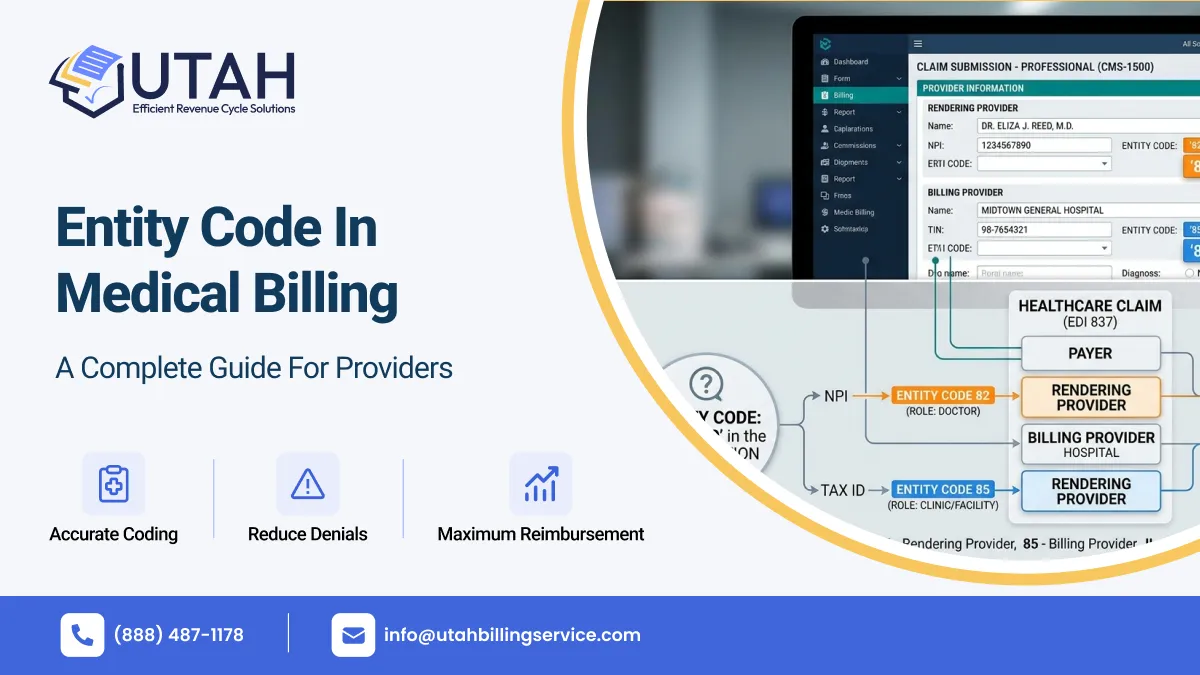
Medical billing depends on accurate communication between healthcare providers, clearinghouses, and insurance payers. Every electronic claim contains information about multiple parties, including the patient, provider, insurance company, and organizations involved in payment. To help claim systems understand the role of each party, healthcare transactions use standardized identifiers called entity codes.
An entity code in medical billing is a standardized identifier used in electronic healthcare claims to show who or what an individual or organization represents within a transaction. These codes help payers correctly identify billing providers, rendering providers, patients, subscribers, and other entities involved in claim processing.
For medical practices, understanding entity codes is important because incorrect entity information can lead to claim rejections, delayed reimbursement, and additional administrative work. This guide explains what entity codes mean, where they appear, common entity code examples, rejection causes, and how billing teams can avoid related claim problems.
An entity code in medical billing is a short numeric or alphanumeric identifier that tells a payer the role of a person, organization, or other party listed on an electronic healthcare claim.
In simple terms:
The entity code explains what role someone has on a claim, while identifiers such as an NPI or Tax ID identify the specific person or organization.
For example:
Entity codes are commonly used within HIPAA-standard electronic transactions, including the 837 Professional (837P) and 837 Institutional (837I) claim formats. They are generally found within the NM1 segment of electronic claim files.
Entity codes help create a common language between healthcare providers, billing systems, clearinghouses, and insurance companies.
Without entity codes, claim processing systems would not know:
Accurate entity coding supports:
Insurance companies process millions of healthcare claims electronically. Entity codes help automated systems identify each participant correctly.
Incorrect entity information can cause claims to fail during electronic validation before they reach payer adjudication.
Examples include:
Claim accuracy affects every stage of the revenue cycle. Entity errors can create unnecessary follow-up work for billing teams and delay reimbursement.
Entity codes are part of the electronic data exchange process used in healthcare billing.
When a medical practice submits a claim electronically, the claim contains different sections identifying parties involved in the transaction.
A simplified claim workflow looks like this:
During this process, entity codes help identify the purpose of each name and identification number included in the claim.
For example:
A billing provider entry tells the payer which organization is requesting payment.
A rendering provider entry tells the payer which individual performed the service.
A patient entry identifies who received care.
There are many entity identifier codes available within electronic healthcare transactions. The following are some of the most common codes encountered in medical billing.
| Entity Code | Entity Role | Meaning |
|---|---|---|
| 85 | Billing Provider | Organization or provider submitting the claim |
| 82 | Rendering Provider | Healthcare professional who performed the service |
| 87 | Pay-to Provider | Entity receiving payment when different from billing provider |
| IL | Subscriber | Individual who holds the insurance policy |
| QC | Patient | Person who received healthcare services |
| PR | Payer | Insurance company responsible for processing the claim |
| DN | Referring Provider | Provider who referred the patient for services |
| 77 | Service Location | Location where services were performed |
The exact use of an entity code depends on the claim type, payer requirements, and transaction format.
A common misunderstanding is confusing entity codes with provider identifiers such as NPIs.
They serve different purposes.
| Entity Code | NPI |
|---|---|
| Identifies the role of an entity on a claim | Identifies the healthcare provider or organization |
| Explains “who is this party in this transaction?” | Explains “which provider or organization is this?” |
| Usually appears with claim segments | A unique 10-digit provider identifier |
Example:
A physician’s NPI identifies the physician.
An entity code such as 82 tells the payer that the physician is the rendering provider for that specific claim.
Entity codes commonly appear in electronic claim transactions, especially within the NM1 (Name) segment.
The NM1 segment provides information about individuals and organizations involved in the claim.
Common locations include:
The billing provider is typically identified separately from the provider who performed the service.
Example:
A medical group submits a claim while one physician provides treatment.
The billing provider may represent the group, while the rendering provider represents the physician.
The rendering provider identifies the healthcare professional responsible for performing the service.
Entity codes help distinguish between:
These individuals may be the same person, but they are not always the same entity.
When a payer or clearinghouse refers to the use of an entity code, it means the claim requires proper identification of the role associated with a person or organization.
For example:
A claim may contain:
However, without the correct entity role, the payer may not know whether that information belongs to:
The entity code provides that missing context.
Entity code rejection medical billing problems usually occur when the information attached to an entity role does not match payer expectations.
Common causes include:
A claim may reject when the billing provider entity does not match:
Some services require the individual provider who performed the service to be reported correctly.
Missing or incorrect rendering provider information can delay claim processing.
A claim may reject when subscriber and patient information does not match insurance records.
Examples:
Practice management systems and clearinghouses automatically map entity information.
Incorrect setup can cause repeated claim errors.
When an entity code-related rejection occurs, billing teams should follow a structured review process.
Identify which entity the payer is referencing.
The issue may relate to:
Check:
Confirm that the billing software is assigning the correct entity role.
Different payers may have specific electronic claim requirements.
Always review payer-specific guidance when necessary.
After identifying the problem, update the claim information and submit according to payer procedures.
Healthcare organizations can reduce entity-related claim issues by following these practices:
Keep provider information updated across:
Billing teams should understand the difference between:
Before submission, review claims for missing or inconsistent entity information.
Repeated entity code errors may indicate a system configuration issue rather than individual billing mistakes.
Entity code accuracy plays an important role in revenue cycle management because claim submission depends on correct data relationships.
A claim may contain accurate:
Yet still fail if the entities involved are incorrectly identified.
Medical billing teams should view entity codes as part of overall claim quality, not as a separate technical issue.
What is an entity code in medical billing?
An entity code in medical billing is an identifier used in electronic healthcare claims to show the role of each person or organization involved in the transaction, such as the billing provider, patient, subscriber, or payer.
Is an entity code the same as an NPI?
No. An entity code identifies the role a party plays on a claim, while an NPI identifies the specific healthcare provider or organization.
What causes entity code rejection in medical billing?
Common causes include incorrect provider information, missing claim data, incorrect entity mapping, and mismatched payer records.
Where are entity codes found in electronic claims?
Entity codes are commonly found in electronic claim transactions, including the NM1 segment of HIPAA-standard EDI claim files.
What are common entity codes used in medical billing?
Common examples include 85 for billing provider, 82 for rendering provider, IL for subscriber, QC for patient, and PR for payer.
Can incorrect entity codes delay payment?
Yes. Incorrect entity information may cause claim rejection or require correction before processing can continue.