COPD ICD-10 Code: Complete Guide to Diagnosis and Coding
October 14, 2026
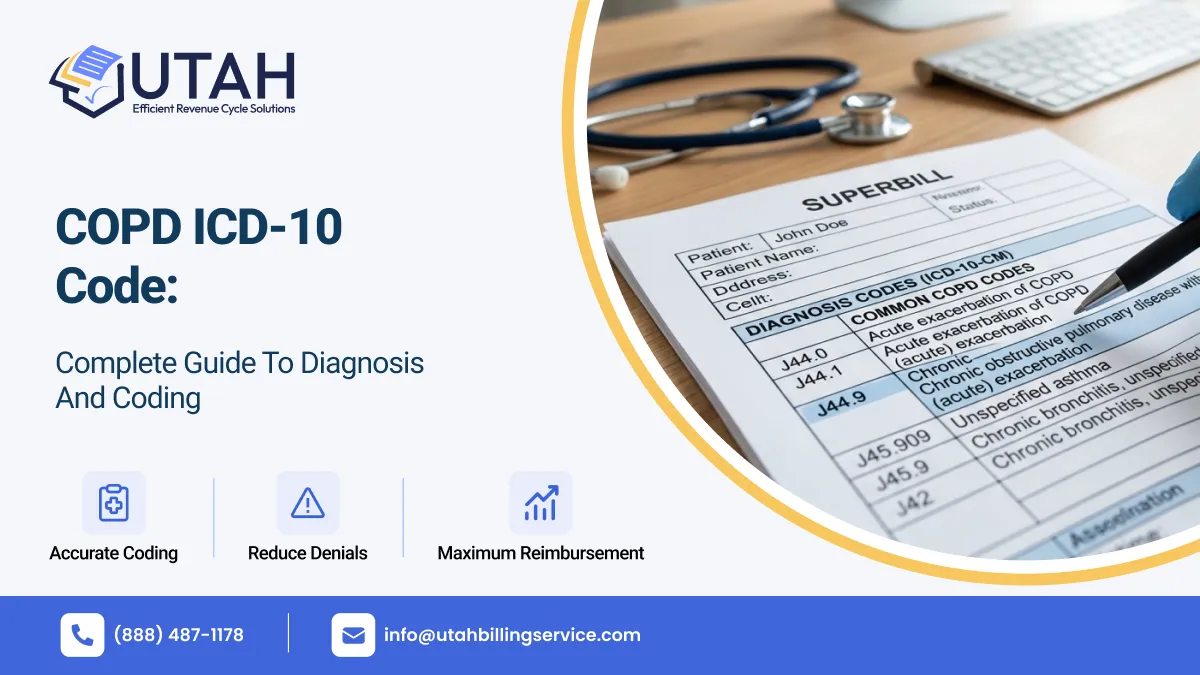
A patient who has obstructive pulmonary disease or COPD might visit for a normal check‑up might suddenly experience a flare‑up of symptoms or might need treatment for a lung infection. Even though the disease COPD is the same each situation can call for a diagnosis code.
That difference matters when you send claims.
The ICD‑10 code for COPD depends on what’s written in the chart during the visit. For example J44.9 is used for COPD when nothing else is added while J44.1 is used when COPD is in a flare‑up. If COPD happens together with an acute respiratory infection J44.0 might be the right code.
Picking the code needs more than just naming the diagnosis. Doctors must also look at conditions, test results, what the chart says and what the insurer requires.
This guide shows the COPD ICD‑10‑CM codes that are used in year 2027. It explains the differences, between them the CPT and HCPCS codes, the billing modifiers and the common reasons claims get denied. The guide is made to help doctors, pulmonologists, hospitals and clinics choose the code and avoid avoidable payment problems.
The ICD-10-CM code most commonly associated with chronic obstructive pulmonary disease is J44.9 – Chronic obstructive pulmonary disease, unspecified.
However, J44.9 is not appropriate for every COPD encounter.
The ICD-10-CM classification relies on category J44 to spot chronic obstructive pulmonary conditions. The ICD-10-CM classification chooses a code based on whether the patient has an acute exacerbation a lower respiratory infection or another documented form of disease.
| ICD-10-CM Code | Description | When to Use |
|---|---|---|
| J44.9 | Chronic obstructive pulmonary disease, unspecified | COPD without a more specific documented condition |
| J44.1 | COPD with acute exacerbation | Documented acute worsening of COPD |
| J44.0 | COPD with acute lower respiratory infection | COPD with pneumonia, acute bronchitis, or another qualifying acute lower respiratory infection |
| J44.89 | Other specified chronic obstructive pulmonary disease | A specified condition classified under this code |
| J44.81 | Bronchiolitis obliterans and bronchiolitis obliterans syndrome | When the specific condition is diagnosed and documented |
Important: J44 and J44.8 are category-level codes and should not be submitted as billable diagnosis codes. Select the appropriate billable code based on the medical record.
Chronic obstructive pulmonary disease is a term respiratory condition. It is marked by a lasting blockage of airflow. The disease can lead to trouble breathing. This trouble gets worse over time. Starts to affect everyday tasks.
People who have this condition might feel out of breath. They might have a cough that never goes away. They could make a lot of mucus. They might also hear a whistling sound when they breathe. Their ability to exercise might get weaker.
COPD often includes bronchitis. It can also include emphysema. Sometimes it has features of both. This is a lung disease.
Smoking is the cause. Other things matter too. Exposure to dust or chemicals at work can help. Pollution, in the air is another factor. Some people have a condition. Other environmental things can play a role well.
A diagnosis usually includes an evaluation and tests of lung function.
Providers look at the patients symptoms what they have been exposed to any lung problems and what they find on a physical exam. Spirometry is key to confirm that airflow is still blocked.
The Global Initiative for Chronic Obstructive Lung Disease (GOLD) says that a post-bronchodilator FEV1/FVC ratio lower than 0.70 helps confirm the diagnosis when it is looked, at together with the patients findings.
Other tests can include chest X‑ray or CT checking oxygen levels, arterial blood gas tests or more lung function studies.
These results help set up and evaluate the disease. The diagnosis code should match what the provider writes down as the clinical conclusion, not just one test result.
J44.9 is the choice when the provider says a patient has COPD but does not write down any signs of an acute flare-up an acute lower respiratory infection or any other condition that has a more specific code.
This code is often used during outpatient visits where the COPD is stable and being managed.
For example a patient goes to a pulmonologist for a check-up. Their breathing is steady. The doctor looks over their medications. There is no mention of an exacerbation or any infection in the notes.
If the diagnosis is only listed as COPD then J44.9 can be used.
It is important to remember that J44.9 should not be used to replace more accurate codes when the patient’s condition clearly matches a different more specific classification.
A frequent coding mistake happens when J44.9 is used every time a patient, with COPD visits even when the provider has clearly described worsening symptoms or an acute episode. That kind of documentation calls for a more detailed code.
J44.1 identifies COPD with an acute exacerbation.
An exacerbation happens when a patient’s respiratory symptoms become worse than the patient’s baseline.
During an exacerbation a patient may feel breathlessness cough more strongly produce more sputum or notice changes, in the sputum’s color or thickness.
When an exacerbation occurs a patient may need to change medication or receive treatment.
J44.1 is the code when a treating provider has documented an acute COPD exacerbation.
Take for example a patient who goes to the emergency department because of two days of worsening shortness of breath and wheezing.
The physician examines the patient. Clearly writes in the record that there is an acute COPD exacerbation. That’s when J44.1 should be used.
In this situation, J44.1 is supported by the diagnosis.
However shortness of breath does not establish an exacerbation.
If the documentation only mentions increased breathing difficulty, without a confirmed exacerbation the provider may need to clarify the diagnosis.
An acute exacerbation and an acute respiratory infection are not interchangeable. They represent clinical circumstances and may require separate coding.
J44.0 is used when COPD is recorded with an acute lower respiratory infection.
Examples are pneumonia and acute bronchitis.
The code shows the link, between COPD and an acute lower respiratory infection. It does not name the infection.
Another diagnosis code is therefore needed to name the infection.
Suppose a patient with COPD is diagnosed with pneumonia.
The physician documents both conditions during the encounter.
The coding may include:
| Code | Description |
|---|---|
| J44.0 | COPD with acute lower respiratory infection |
| J18.9 | Pneumonia, unspecified organism |
If the organism or type of pneumonia is documented, a more specific pneumonia code may be appropriate.
Yes, when the patient has both an acute lower respiratory infection and a documented COPD exacerbation.
For example, a patient with COPD develops pneumonia, and the physician also diagnoses an acute COPD exacerbation.
The claim may include:
Both conditions must be supported by documentation.
The first-listed or principal diagnosis depends on the reason for the encounter, the condition chiefly responsible for inpatient admission when applicable, and any relevant sequencing instructions. The presence of an infection does not automatically establish which code must appear first in every setting.
COPD frequently occurs alongside other respiratory conditions. These diagnoses may require additional codes when separately documented and reportable.
| ICD-10 Code | Diagnosis | Coding Consideration |
|---|---|---|
| J43.9 | Emphysema, unspecified | Use according to the documented condition and applicable combination-code instructions |
| J41.0 | Simple chronic bronchitis | Appropriate for specifically documented simple chronic bronchitis |
| J41.1 | Mucopurulent chronic bronchitis | Requires documentation of mucopurulent chronic bronchitis |
| J41.8 | Mixed simple and mucopurulent chronic bronchitis | For documented mixed disease |
| J42 | Unspecified chronic bronchitis | When chronic bronchitis is documented without further specificity |
| J20.9 | Acute bronchitis, unspecified | May be reported with J44.0 when appropriate |
| J18.9 | Pneumonia, unspecified organism | Identifies an associated pneumonia diagnosis |
| J47.9 | Bronchiectasis, uncomplicated | When separately diagnosed and reportable |
| J47.1 | Bronchiectasis with acute exacerbation | Requires a documented exacerbation of bronchiectasis |
| J45.909 | Unspecified asthma, uncomplicated | When asthma is separately documented without further specification |
| J96.11 | Chronic respiratory failure with hypoxia | For documented chronic hypoxic respiratory failure |
| J96.12 | Chronic respiratory failure with hypercapnia | For documented chronic hypercapnic respiratory failure |
| J96.01 | Acute respiratory failure with hypoxia | When confirmed and documented |
| J96.21 | Acute and chronic respiratory failure with hypoxia | For documented acute-on-chronic hypoxic respiratory failure |
| R09.02 | Hypoxemia | When independently reportable |
| R06.02 | Shortness of breath | Used when appropriate under symptom-coding rules |
These codes should not be added just because the patient has COPD.
For example oxygen therapy does not automatically mean respiratory failure. Similarly an unusual imaging result should not be turned into a diagnosis without medical notes.
Some patients have both asthma and COPD.
When both conditions are documented, coding may require an appropriate J44 code and an additional J45 code identifying the type and severity of asthma.
For example, a patient with stable COPD and separately documented moderate persistent asthma without complications may require:
The exact combination must follow current ICD-10-CM instructions and reflect the documented clinical conditions.
Respiratory failure can happen to patients who have advanced COPD or who experience acute episodes.
If a patient arrives with a COPD exacerbation and also with acute respiratory failure that includes hypoxia then both COPD and respiratory failure should be reported.
For example:
These codes are used to identify the conditions.
J44.1 – COPD with acute exacerbation
J96.01 – respiratory failure with hypoxia
When a patient is admitted to a hospital the choice of principal diagnosis depends on the reason for admission and on the condition that has been found to be chiefly responsible after a thorough study.
Having both COPD and respiratory failure does not automatically mean that one of those diagnoses should be set as the diagnosis, in every single case.
Smoking history is clinically relevant to COPD, but the diagnosis code should represent the patient’s documented tobacco-related status.
The following codes may apply:
| ICD-10-CM Code | Description |
|---|---|
| F17.210 | Nicotine dependence, cigarettes, uncomplicated |
| F17.211 | Nicotine dependence, cigarettes, in remission |
| Z87.891 | Personal history of nicotine dependence |
| Z72.0 | Tobacco use |
| Z77.22 | Contact with and suspected exposure to environmental tobacco smoke |
| Z71.6 | Tobacco abuse counseling |
Providers should distinguish active nicotine dependence, tobacco use without documented dependence, exposure, and former smoking status.
These codes are not interchangeable, and mutually inappropriate status combinations should be avoided.
ICD-10-CM codes identify the diagnosis. Current Procedural Terminology (CPT) codes describe the medical services performed.
Patients with COPD may require pulmonary testing, imaging, office visits, inhalation treatment, or pulmonary rehabilitation.
The appropriate CPT code depends on the actual service and its documentation.
| CPT Code | Procedure or Service | Purpose |
|---|---|---|
| 94010 | Spirometry | Measures airflow and lung function |
| 94060 | Bronchodilator responsiveness testing | Spirometry before and after bronchodilator administration |
| 94726 | Plethysmography for lung volumes | Measures lung volumes |
| 94727 | Gas dilution or washout lung volume testing | Alternative lung volume assessment |
| 94729 | Diffusing capacity testing | Evaluates pulmonary gas transfer |
| 94640 | Inhalation treatment for acute airway obstruction | Therapeutic inhalation treatment when supported |
| 94664 | Demonstration or evaluation of inhaler/nebulizer use | Assesses patient use of an aerosol device |
| 94618 | Pulmonary stress testing | Evaluates exercise-related respiratory response |
| 71046 | Chest X-ray, two views | Investigates relevant chest findings |
| 71250 | CT chest without contrast | Evaluates thoracic structures when medically necessary |
| 99212–99215 | Established-patient office or outpatient E/M services | Follow-up evaluation and management |
| 99202–99205 | New-patient office or outpatient E/M services | Initial evaluation and management |
| 99281–99285 | Emergency department E/M services | Emergency assessment and management |
Coding note: Reporting multiple pulmonary function tests, on the date requires attention to CPT instructions, component services, medical necessity and National Correct Coding Initiative (NCCI) edits.
For example CPT 94060 already includes bronchodilator administration as part of diagnostic responsiveness testing. A separate 94640 charge should not be added just because a bronchodilator was used during that test.
HCPCS Level II codes may apply to equipment, supplies, medications, and certain pulmonary rehabilitation services.
| HCPCS Code | Description or Use |
|---|---|
| G0237 | Therapeutic procedures to increase strength or endurance of respiratory muscles, individual |
| G0238 | Therapeutic procedures to improve respiratory function, other than those described by G0237, individual |
| G0239 | Group therapeutic respiratory procedures |
| G0424 | Pulmonary rehabilitation services for moderate to very severe COPD, including monitoring |
| E1390 | Oxygen concentrator, single delivery port |
| E0431 | Portable gaseous oxygen system, rental |
| E0570 | Nebulizer with compressor |
| E0466 | Home ventilator used with a noninvasive interface |
Coverage and reimbursement are not based on the diagnosis code.
For instance a claim for home oxygen needs documentation that meets the payer’s oxygen coverage rules. Just having a COPD diagnosis does not guarantee approval if the required clinical evidence is missing.
In the way pulmonary rehabilitation services must follow the payer’s rules on coverage, supervision, proper documentation and how often the service can be provided.
Providers should always check the payer policies and any updates, to coding guidelines before submitting claims.
Modifiers provide additional information about how a service was performed or why a claim requires special consideration.
Not every COPD-related procedure requires a modifier.
| Modifier | Meaning | COPD Billing Application |
|---|---|---|
| 25 | Significant, separately identifiable E/M service | May apply when an E/M service meets separate reporting criteria on the day of another procedure |
| 59 | Distinct procedural service | May identify a distinct service when supported by NCCI rules |
| 26 | Professional component | Reporting eligible physician interpretation services |
| TC | Technical component | Reporting eligible technical portions of diagnostic services |
| 76 | Repeat procedure by the same physician or other qualified professional | When a repeat service meets reporting requirements |
| 77 | Repeat procedure by another physician or qualified professional | When a repeat service is separately reportable |
| KX | Requirements specified in the applicable medical policy have been met | Used for certain covered services or equipment when required |
| GA | Waiver of liability statement issued as required by payer policy | May apply in qualifying Medicare advance beneficiary notice situations |
| GY | Item or service statutorily excluded or not a Medicare benefit | Used when applicable under Medicare rules |
A patient with COPD visits a clinic for an acute respiratory complaint.
The physician performs a medically necessary evaluation and also provides a therapeutic inhalation treatment.
If a separately identifiable E/M service is documented and reporting rules permit separate payment, modifier 25 may be appropriate on the E/M code.
However, modifier 25 should not be applied automatically whenever an office visit and treatment occur on the same day.
The documentation must support the separate E/M work beyond the services normally included in the procedure.
Modifier 59 may sometimes identify distinct procedural services that would otherwise be subject to bundling edits.
Its use requires evidence that the services meet the applicable distinctness criteria.
It should not be used merely to bypass an NCCI edit or obtain payment for a bundled service.
Good COPD documentation does not need to be complicated, but it must explain what the provider evaluated, diagnosed, and treated.
Missing clinical details can make it difficult to select the appropriate diagnosis or demonstrate medical necessity.
The record should establish whether the patient has stable COPD, an acute exacerbation, or COPD with an acute lower respiratory infection.
Terms such as “worsening breathing” may describe symptoms but do not always establish a definitive exacerbation diagnosis.
Depending on the encounter, useful information may include:
Pneumonia, asthma, bronchiectasis, and respiratory failure should be clearly documented when diagnosed.
Each condition must meet applicable reporting criteria.
A patient undergoing pulmonary function testing should have documentation showing why the testing was needed.
For instance, a physician may order spirometry to evaluate suspected persistent airflow limitation or investigate changes in respiratory symptoms.
The documentation should support both the procedure performed and the diagnosis associated with the service.
Changes in bronchodilator treatment, steroid therapy, oxygen management, referrals, or follow-up arrangements help describe the services performed during the encounter.
These details are particularly important when supporting an evaluation and management service.
Even when the diagnosis is correct, COPD claims may be rejected or denied because of coding inconsistencies, insufficient information, coverage restrictions, or documentation problems.
Understanding the reason for a denial helps providers determine whether the claim needs correction, additional records, or a formal appeal.
| CARC | General Meaning | Possible COPD-Related Issue |
|---|---|---|
| CO-16 | Claim lacks information or contains a submission/billing error | Missing or invalid claim details |
| CO-50 | Services are not deemed medically necessary by the payer | Pulmonary testing or treatment lacks sufficient support |
| CO-96 | Non-covered charge | Service is excluded or does not meet coverage requirements |
| CO-97 | Service is included in payment for another service | Bundled respiratory procedures |
| CO-18 | Duplicate claim or service | Repeat submission of the same service |
| CO-197 | Precertification, authorization, or notification absent | Authorization requirement not met |
| CO-109 | Claim not covered by this payer or contractor | Claim submitted to an incorrect payer |
| CO-11 | Diagnosis inconsistent with the procedure | Diagnosis-to-service inconsistency under payer rules |
The CO prefix indicates contractual obligation. The exact adjustment group may differ depending on the adjudication. CARC descriptions and payer usage should be checked against the remittance advice.
RARCs provide additional information about payment adjustments and denial decisions.
Unlike diagnosis codes, RARCs are not selected by the provider when submitting an ordinary claim. They appear on the payer’s remittance advice.
Some examples relevant to claim review include:
| RARC | General Meaning | Recommended Review |
|---|---|---|
| M51 | Missing, incomplete, or invalid procedure code information | Verify procedure code data and applicable claim details |
| N115 | Decision based on a local coverage determination (LCD) | Review the referenced Medicare contractor policy |
| N130 | Consult plan benefit documents or guidelines for restrictions | Review benefit and coverage requirements |
These are examples, not RARCs unique to COPD. Always use the full CARC/RARC combination and current payer explanation to determine the actual reason for the adjustment.
A COPD claim may be clinically justified but still require correction before payment.
The following practices help address recurring problems.
The ICD-10-CM code should represent the condition documented during the visit.
A claim for an acute exacerbation should not rely on J44.9 when J44.1 is supported and more appropriate.
Pulmonary function testing, imaging, and respiratory treatments should be associated with diagnoses that explain the medical necessity of those services.
Avoid using a diagnosis solely because it may be accepted by the payer.
Before separately reporting diagnostic or therapeutic respiratory procedures, check current NCCI edits and relevant CPT instructions.
Review authorization, referral, frequency, and documentation requirements for the patient’s plan.
This is especially important for durable medical equipment, oxygen therapy, and pulmonary rehabilitation.
If a claim is denied for medical necessity, review the payer’s coverage criteria and the documentation from the date of service.
A corrected claim may resolve a submission error, whereas an appeal supported by clinical records may be needed when the disagreement concerns coverage or medical necessity.
At Utah Billing Service, the focus is on aligning documented diagnoses with accurately reported services, helping healthcare providers identify claim issues before they interfere with reimbursement.
Several coding problems occur repeatedly in pulmonary practices.
One is treating all COPD visits the same, regardless of whether an exacerbation or infection is present.
Another is assigning an exacerbation code solely because a patient reports increased shortness of breath.
Inconsistent documentation of pneumonia, asthma, and respiratory failure can also lead to inaccurate diagnosis selection.
Problems may arise when providers report separately billed respiratory services without checking bundling rules, or when equipment claims lack the documentation required by the patient’s coverage policy.
The most useful prevention strategy is straightforward: document the clinical condition clearly, choose codes that reflect the documented diagnosis, and verify service-specific billing requirements before submission.
Respiratory care often involves multiple services, including office visits, pulmonary testing, imaging, treatment, and long-term equipment needs. Each service may have different coding and coverage requirements.
Utah Billing Service supports healthcare providers with medical billing processes such as claims management, denial follow-up, coding coordination, and revenue cycle support.
For physicians, hospitals, and pulmonary clinics, careful attention to COPD diagnosis codes, supporting documentation, and payer requirements can help reduce avoidable claims problems and improve reimbursement consistency.
J44.9 is the ICD-10-CM code for chronic obstructive pulmonary disease, unspecified. Other codes may be appropriate when the patient has an acute exacerbation, acute lower respiratory infection, or another specified condition.
J44.1 is used for chronic obstructive pulmonary disease with acute exacerbation. The exacerbation must be supported by the provider’s documentation.
J44.0 may be reported for COPD with an acute lower respiratory infection, along with an additional code identifying pneumonia, such as J18.9 when the organism is unspecified. J44.1 may also apply if a COPD exacerbation is separately documented.
Yes. When COPD and asthma are both documented, the appropriate COPD and asthma codes may be reported according to ICD-10-CM instructions. The specific asthma code depends on the documented type, severity, and status.
Yes. J44.9 is a billable ICD-10-CM diagnosis code for COPD, unspecified. However, a more specific code should be selected when supported by documentation and required by the classification.
CPT 94010 is commonly used for spirometry. CPT 94060 applies to bronchodilator responsiveness testing, while additional pulmonary function codes may be used depending on the procedures performed.
Both COPD and respiratory failure may need separate codes when the conditions are documented and reportable. The specific respiratory failure code depends on whether the condition is acute, chronic, or acute-on-chronic, and whether hypoxia or hypercapnia is documented.
Accurate COPD coding begins with understanding the patient’s current condition.
A stable follow-up visit, an acute exacerbation, and COPD with pneumonia may involve the same underlying disease, but they do not always support the same diagnosis code.
Using J44.9, J44.1, J44.0, and other applicable codes correctly helps ensure that claims reflect the care provided.
For healthcare providers, the goal is not simply to select a billable code. It is to connect the documented diagnosis with the services performed, follow current coding instructions, and maintain the clinical evidence needed to support medical necessity.
Clear documentation, appropriate code selection, and careful claim review remain essential to accurate COPD billing.