Colon Cancer ICD-10 Code: A Complete Guide for Medical Coding
September 16, 2026
When the medical record says, “colon cancer,” it can seem easy to label colon cancer. In actual clinical coding and medical billing practice, the correct ICD 10 code for colon cancer depends on such details as the documented anatomic site, whether the malignancy is current or historical, whether the tumor is primary or metastatic, the reason for the encounter, and the procedures performed. A diagnosis suitable for a primary sigmoid colon tumor may be unsuitable for a rectosigmoid tumor, metastatic disease, a follow-up examination, or a screening colonoscopy.
Financial and operational differences are important. Claim denials, medical necessity changes, wrong reimbursement, delayed payments, coding queries, documentation issues, audit exposure, etc. Wrong diagnostic code. In addition, diagnosis coding must support the service provided on the claim. A screening colonoscopy , a diagnostic colonoscopy for rectal bleeding , a cancer surveillance visit , a chemotherapy encounter , and a current cancer treatment encounter all include the colon . But each requires different coding systems.
This guide covers the ICD‑10 codes, for colon cancer. It shows how to tell apart colon, rectosigmoid and rectal cancers. It also explains how screening differs from testing. Guide shows how ICD‑10‑CM works with CPT and HCPCS procedure codes. Guide lists what documentation billing teams should check before submitting a claim.
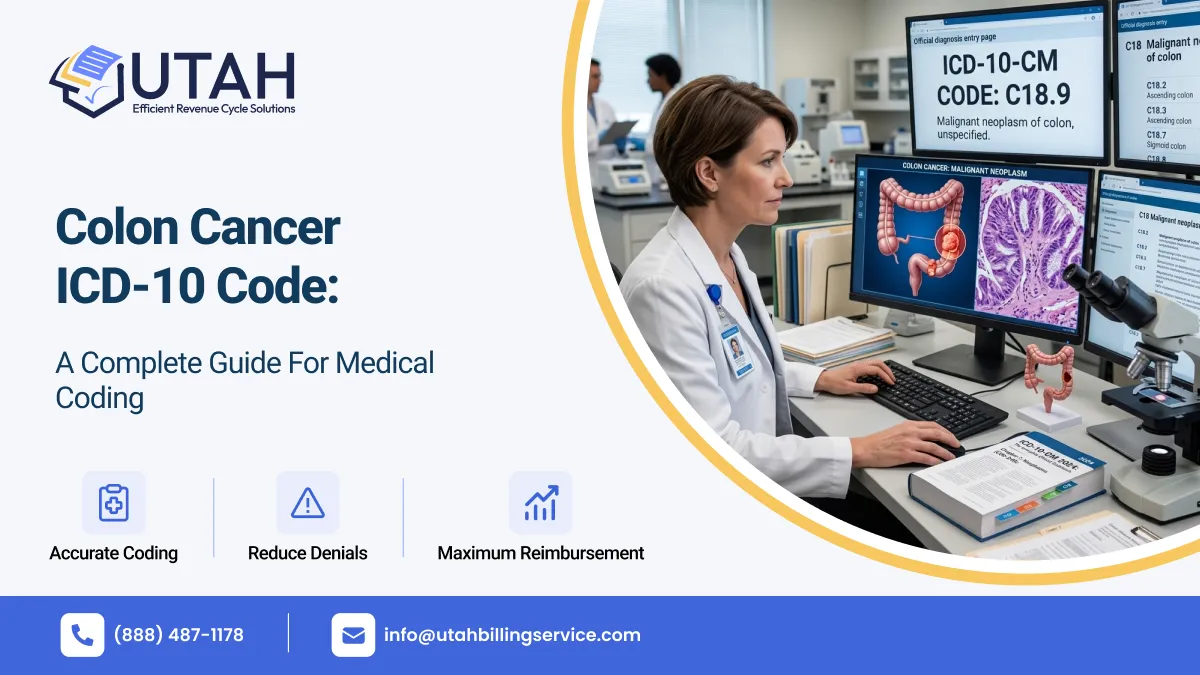
The most prevalent ICD 10 classification for colon cancer when the medical record does not specify a more precise colon site is C18.9 — Malignant neoplasm of colon, unspecified.
However, C18.9 should not automatically be used whenever the provider documents colon cancer. ICD-10-CM provides more specific codes for the cecum, appendix, ascending colon, hepatic flexure, transverse colon, splenic flexure, descending colon, sigmoid colon, and overlapping lesions of the colon.
For example:
This difference matters a lot because ICD-10-CM codes these sites in ways. The coder must go by the diagnosis that the clinician has written down. The coder should not decide the site on their own just by looking at an imaging report pathologic terms or guesses, about anatomy. This can only happen if the official coding guidelines say it is okay to use that kind of documentation.
If a surgeon documents:
Adenocarcinoma of the sigmoid colon
the appropriate primary malignancy code is generally C18.7 — Malignant neoplasm of sigmoid colon.
If the surgeon documents only:
Colon adenocarcinoma
and no site is established in the documentation available for coding, C18.9 may be appropriate.
The basic approach is this: code to the utmost level of precision supported by the provider documentation and the appropriate ICD-10-CM standards.
The ICD-10-CM code set is effective for services rendered on September 15, 2026.
The FY 2026 ICD-10-CM year generally includes services from October 1, 2025, through September 30, 2026. An additional update for April 1, 2026 covers services delivered from April 1 through September 30, 2026.
This indicates that a coding department should not choose a diagnosis code solely because it appears in a current web search result. The code set shall indicate the applicable date of service or discharge.
The next yearly ICD-10-CM cycle, FY 2027, starts October 1, 2026. Therefore, for claims with dates of service on or after October 1, 2026, check the FY 2027 code set instead of automatically applying FY 2026 codes.
The official ICD-10-CM conventions and recommendations continue to be critical to hospital coding, outpatient coding, professional claims, and facility billing. The Alphabetical Index and Tabular List take precedence over common assumptions about how a diagnosis should be coded.
| Condition or Scenario | ICD-10-CM Code | Official Description |
|---|---|---|
| Malignant neoplasm of cecum | C18.0 | Malignant neoplasm of cecum |
| Malignant neoplasm of appendix | C18.1 | Malignant neoplasm of appendix |
| Malignant neoplasm of ascending colon | C18.2 | Malignant neoplasm of ascending colon |
| Malignant neoplasm of hepatic flexure | C18.3 | Malignant neoplasm of hepatic flexure |
| Malignant neoplasm of transverse colon | C18.4 | Malignant neoplasm of transverse colon |
| Malignant neoplasm of splenic flexure | C18.5 | Malignant neoplasm of splenic flexure |
| Malignant neoplasm of descending colon | C18.6 | Malignant neoplasm of descending colon |
| Malignant neoplasm of sigmoid colon | C18.7 | Malignant neoplasm of sigmoid colon |
| Overlapping lesion of colon | C18.8 | Malignant neoplasm of overlapping sites of colon |
| Colon cancer, site unspecified | C18.9 | Malignant neoplasm of colon, unspecified |
| Malignant neoplasm of rectosigmoid junction | C19 | Malignant neoplasm of rectosigmoid junction |
| Malignant neoplasm of rectum | C20 | Malignant neoplasm of rectum |
| Secondary malignant neoplasm of large intestine and rectum | C78.5 | Secondary malignant neoplasm of large intestine and rectum |
| Secondary malignant neoplasm of liver/intrahepatic bile duct | C78.7 | Secondary malignant neoplasm of liver and intrahepatic bile duct |
| Encounter for screening for malignant neoplasm of colon | Z12.11 | Encounter for screening for malignant neoplasm of colon |
| Follow-up examination after completed cancer treatment | Z08 | Encounter for follow-up examination after completed treatment for malignant neoplasm |
| Personal history of malignant neoplasm of large intestine | Z85.038 | Personal history of other malignant neoplasm of large intestine |
| Personal history involving rectum/rectosigmoid/anus | Z85.048 | Personal history of other malignant neoplasm of rectum, rectosigmoid junction, and anus |
| Encounter for antineoplastic chemotherapy | Z51.11 | Encounter for antineoplastic chemotherapy |
| Encounter for antineoplastic radiation therapy | Z51.0 | Encounter for antineoplastic radiation therapy |
The C18 category covers primary malignant neoplasms of the colon. The anatomic distinctions within C18 are important for accurate coding. C19 identifies the rectosigmoid junction, while C20 identifies the rectum.
C18.8 is used when documentation supports an overlapping lesion of the colon and the point of origin cannot be determined. It should not be selected merely because a tumor is large or involves several areas. The documentation must support the classification.
A patient can have both an active primary colon malignancy and metastatic disease. Depending on the clinical circumstances and documentation, additional codes may identify secondary malignant sites.
C78.5 is the code for secondary malignant neoplasm of large intestine and rectum. C78.7 is the code for secondary malignant neoplasm of liver and intrahepatic bile duct.
The coding crew should not automatically presume that all liver lesions in a patient with colon cancer are metastases. There must be sufficient provider documentation to support the diagnosis.
The first step is to determine what diagnosis the responsible provider has documented.
Look for terminology such as:
The coder should not convert a clinical suspicion into a confirmed malignancy simply because an imaging study, colonoscopy, or laboratory result looks suspicious.
For example, a colonoscopy report stating “mass suspicious for malignancy” is not automatically equivalent to a provider-documented confirmed colon cancer diagnosis for every coding situation.
Site specificity is one of the most important decisions in colon cancer coding.
The C18 category includes:
If the provider documents a specific site, the more specific code should generally be considered instead of C18.9.
A physician documents:
“Primary adenocarcinoma of the sigmoid colon.”
The relevant diagnosis code is:
C18.7 — Malignant neoplasm of sigmoid colon
This is the appropriate type of code for a documented primary sigmoid malignancy. It is not necessary to use C18.9 simply because “colon cancer” is the broader condition.
This is a frequent source of coding errors.
The following are separate ICD-10-CM categories:
Therefore, the commonly searched phrase “ICD 10 code for rectal cancer” does not point to the same code as colon cancer.
For a documented primary rectal malignancy, the main code is:
C20 — Malignant neoplasm of rectum
For a documented rectosigmoid junction malignancy:
C19 — Malignant neoplasm of rectosigmoid junction
The provider’s documented site should determine the code rather than the coder trying to infer whether a tumor “sounds more like” colon or rectal cancer.
The record should be reviewed for evidence that the tumor represents:
These situations can result in very different diagnosis coding.
For example, C18.9 represents a primary malignant neoplasm of the colon when the documentation supports that diagnosis. C78.5 represents secondary malignant neoplasm of the large intestine and rectum.
A patient with colon cancer metastatic to the liver may require coding of the documented primary malignancy and the secondary liver malignancy when appropriate.
This distinction has major billing implications.
If a patient is receiving active treatment for a current malignancy, an active malignant neoplasm code may be appropriate.
If the malignancy was previously treated and is no longer present, a personal-history code may be more appropriate.
For example:
Z85.038 identifies personal history of other malignant neoplasm of the large intestine.
This should not simply replace an active C18 code whenever a patient has a cancer history. The coding decision depends on whether the cancer remains current and whether the encounter concerns active disease, follow-up, surveillance, or another condition.
For an encounter specifically for follow-up after completed treatment for a malignant neoplasm, Z08 may be relevant, with an additional personal-history code identifying the prior malignancy when required.
This is different from an encounter where the patient continues to receive active cancer treatment.
The reason for the encounter can change the coding approach substantially.
Consider these examples:
| Encounter | Potential Coding Focus |
|---|---|
| Newly diagnosed colon cancer | Active malignancy code based on documented site |
| Colonoscopy because of rectal bleeding | Symptom/diagnostic indication as appropriate |
| Routine colorectal cancer screening | Z12.11 |
| Follow-up after completed cancer treatment | Z08 plus appropriate history code |
| Active chemotherapy | Z51.11 and applicable malignancy coding |
| Radiation treatment | Z51.0 and applicable malignancy coding |
| Evaluation of metastatic disease | Primary and secondary malignancy codes as documented |
| Surveillance after prior cancer | Follow-up/history framework, depending on documentation and purpose |
This is why searching for a single “colon cancer code” is often insufficient for claims processing.
Finding a code in the Alphabetic Index is only the beginning.
The coder should review the corresponding Tabular List entry and applicable:
ICD-10-CM requires the full code and applicable characters. Reporting a category such as C18 rather than a valid reportable code is not sufficient when the category has additional subdivisions.
Diagnosis sequencing is not simply a matter of choosing the most serious condition.
For inpatient coding, outpatient coding, screening services, cancer treatment, and follow-up encounters, different rules may apply.
For example, a screening encounter is not automatically coded as active colon cancer merely because a polyp or malignancy is discovered during the procedure. The coding must reflect the circumstances and the applicable official rules.
Similarly, an encounter for chemotherapy has specific sequencing considerations, while an encounter for a symptom such as rectal bleeding may be coded differently when the cause has not yet been established.
The diagnosis code should support the service being billed, but a diagnosis code by itself does not guarantee coverage.
Medical necessity can depend on:
A claim can contain a technically valid ICD-10-CM code and still deny if the procedure is not covered for that indication or if documentation does not establish medical necessity.
One of the most important distinctions in colorectal billing is the difference between screening and diagnostic evaluation.
The primary ICD-10-CM screening code is:
Z12.11 — Encounter for screening for malignant neoplasm of colon
A screening encounter generally means the patient is being evaluated for colorectal cancer despite not having a known symptom or established cancer that is driving the examination.
A patient undergoing a colonoscopy because of:
may have a diagnostic indication rather than a purely screening indication.
Screening and diagnostic procedures can have different coverage and cost-sharing rules.
For Medicare, colorectal cancer screening services include specific HCPCS codes and coverage requirements. Common Medicare screening colonoscopy codes include:
Other colorectal screening services use additional HCPCS or CPT codes depending on the test.
If a screening colonoscopy results in removal or biopsy of a lesion, claim processing can become more complicated. The procedure actually performed, the screening status, applicable modifiers, diagnosis coding, and payer-specific rules all need to be considered.
A screening diagnosis should not be added simply to obtain preventive coverage when the encounter was actually diagnostic.
ICD-10-CM describes the diagnosis. CPT and HCPCS codes describe procedures, services, supplies, or other billable items.
A colon cancer claim may involve several different code families depending on what was performed.
Some commonly encountered CPT codes include:
| CPT/HCPCS | Common billing use |
|---|---|
| 45378 | Colonoscopy, flexible; diagnostic examination |
| 45380 | Colonoscopy with biopsy |
| 45381 | Colonoscopy with directed submucosal injection |
| 45382 | Colonoscopy with control of bleeding |
| 45383 | Colonoscopy with removal/destruction of lesion by appropriate technique |
| 45384 | Colonoscopy with removal of lesion by hot biopsy forceps |
| 45385 | Colonoscopy with removal of tumor, polyp, or other lesion by snare technique |
| G0104 | Medicare colorectal cancer screening by flexible sigmoidoscopy |
| G0105 | Medicare colorectal cancer screening colonoscopy for high-risk individual |
| G0121 | Medicare colorectal cancer screening colonoscopy for individual not meeting high-risk criteria |
| G0328 | Medicare colorectal cancer screening fecal occult blood test using immunoassay |
The exact CPT descriptor and annual code-set status should be verified against the current CPT publication and payer-specific billing requirements before claim submission.
Do not select a procedure code based only on the diagnosis.
For example, C18.7 tells the payer that the patient has a documented malignant neoplasm of the sigmoid colon. It does not tell the payer that a colonoscopy, biopsy, polypectomy, colectomy, pathology service, chemotherapy administration, or imaging service occurred.
The procedure must be supported separately by the medical record.
Colon cancer frequently involves pathology services after a biopsy or surgical specimen.
Depending on the specimen and service, pathology CPT codes may be reported by the pathology provider. A commonly encountered surgical pathology code is 88305, although the appropriate pathology code depends on the specimen and level of service actually performed.
The diagnosis supporting pathology should accurately describe the condition documented by the treating provider and/or pathology documentation as permitted by the applicable coding rules.
Billing teams should avoid automatically attaching a colon cancer diagnosis to every pathology claim merely because the patient ultimately received a cancer diagnosis. The diagnosis supporting the pathology service must reflect the documentation and circumstances of that specific service.
Treatment of colon cancer may involve procedures such as:
The appropriate CPT code depends on the actual surgical procedure, approach, anatomic extent, and circumstances.
The ICD-10-CM diagnosis identifies the malignancy and other reportable conditions. The CPT procedure code identifies the operation.
For facility inpatient claims, ICD-10-PCS may be used instead of CPT for reporting inpatient hospital procedures. ICD-10-PCS and ICD-10-CM should not be treated as interchangeable systems.
Cancer treatment claims can involve diagnosis codes as well as administration, drug, and treatment codes.
For an encounter specifically for antineoplastic chemotherapy, Z51.11 may be applicable.
For an encounter specifically for antineoplastic radiation therapy, Z51.0 may be applicable.
Additional codes may identify the malignancy and other conditions addressed during treatment.
Drug administration and oncology treatment coding can involve CPT and HCPCS codes, including drug-specific HCPCS codes. The exact code depends on the medication, dosage, route, administration service, and payer requirements.
Billing teams should verify:
The search term gastric cancer ICD 10 sometimes appears alongside colon cancer coding research because both conditions involve gastrointestinal oncology.
However, gastric cancer and colon cancer are coded to different ICD-10-CM categories.
Gastric or stomach malignancies are generally found under C16.-, while colon malignancies are under C18.-.
For example, a malignant neoplasm of the stomach, unspecified site is classified under C16.9.
A coder should never select a gastric cancer code merely because a patient with colon cancer has upper gastrointestinal symptoms or undergoes an upper endoscopy.
The anatomical site documented by the provider remains essential.
Colon cancer patients often have additional conditions that affect treatment, risk, medical necessity, or resource utilization.
Depending on the documentation and applicable coding rules, additional diagnoses can include:
These diagnoses should not be added simply because they appear somewhere in the patient’s historical record. The condition must meet the applicable reporting requirements for the encounter.
This is particularly important in inpatient coding, where secondary diagnoses can affect severity-of-illness and reimbursement calculations.
Accurate diagnosis coding begins with accurate clinical documentation.
The following checklist can help physicians, hospitals, coding teams, and billing departments identify gaps before a claim is submitted.
| Documentation Element | What the Record Should Establish | Why It Matters |
|---|---|---|
| Cancer diagnosis | Confirmed provider-documented malignancy when applicable | Establishes the basis for cancer coding |
| Primary site | Cecum, ascending, transverse, descending, sigmoid, etc. | Supports the most specific C18 code |
| Rectosigmoid involvement | Whether tumor is at rectosigmoid junction | Distinguishes C19 from C18/C20 |
| Rectal involvement | Provider-documented rectal malignancy | Supports C20 when appropriate |
| Histology | Relevant documented pathology/clinical diagnosis | Helps describe the condition but does not replace site coding |
| Current versus historical disease | Active, treated, recurrent, or history | Determines whether active C codes or history/follow-up codes may apply |
| Metastatic disease | Documented secondary sites | Supports appropriate secondary malignancy codes |
| Encounter purpose | Screening, diagnostic evaluation, treatment, follow-up, etc. | Critical for diagnosis sequencing and medical necessity |
| Symptoms | Bleeding, anemia, pain, bowel changes, etc. | May support diagnostic encounters when relevant |
| Treatment | Surgery, chemotherapy, radiation, etc. | Supports appropriate treatment coding |
| Procedure performed | Exact service and technique | Supports CPT/HCPCS selection |
| Pathology | Specimen and diagnostic findings | Supports pathology and clinical documentation |
| Medical necessity | Clinical reason for the service | Reduces avoidable payer disputes |
| Prior cancer treatment | Treatment completion and surveillance status | Helps distinguish active disease from history/follow-up |
A statement such as:
“Colon cancer”
is less useful for coding than:
“Adenocarcinoma of the descending colon.”
Similarly:
“History of colon cancer”
does not necessarily establish whether the patient is receiving active treatment, undergoing routine surveillance, or being evaluated for recurrence.
Clear documentation allows coders to select a defensible code without guessing.
Documentation:
“Biopsy-proven adenocarcinoma of the sigmoid colon. Patient scheduled for surgical consultation.”
Primary diagnosis:
C18.7 — Malignant neoplasm of sigmoid colon
The documentation identifies both malignancy and site, so the unspecified colon code would generally be less appropriate.
If the provider clearly documents sigmoid colon cancer, using C18.9 sacrifices available specificity.
Better approach: Review the documentation for the exact colon segment and select the corresponding code.
A patient who completed treatment and has no current malignancy should not automatically continue to receive an active C18 code.
Better approach: Determine whether the cancer is active, recurrent, under treatment, or historical.
A patient with rectal bleeding who undergoes colonoscopy is not automatically a screening patient simply because the colonoscopy also evaluates for cancer.
Better approach: Establish the actual reason for the service and apply the applicable coding and payer rules.
C18 and C20 represent different anatomic sites.
Better approach: Follow the provider’s documented primary site.
A polyp, mass, abnormal imaging finding, or suspicious lesion is not automatically a confirmed malignant neoplasm.
Better approach: Follow the applicable outpatient or inpatient coding rules and provider documentation requirements.
A history of colon cancer does not prove that a current liver or lung lesion is metastatic.
Better approach: Require appropriate provider documentation before assigning secondary malignancy codes.
A valid ICD-10-CM code does not guarantee payment.
Better approach: Check payer medical policies, authorization requirements, screening rules, frequency limits, NCDs, LCDs, and claim-edit requirements.
Diagnosis coding and procedure coding work together on a claim.
For example:
Diagnosis:
C18.7 — Malignant neoplasm of sigmoid colon
Procedure:
A colonoscopy, biopsy, surgery, imaging study, pathology service, chemotherapy administration, or other service, depending on what was actually performed.
The procedure code tells the payer what was done. The diagnosis code helps establish why the service was medically necessary.
That relationship is particularly important for:
A mismatch between the diagnosis and procedure can result in payer edits.
For example, a claim for a screening colonoscopy should be reviewed differently from a claim for a diagnostic colonoscopy performed because of active gastrointestinal symptoms.
Medical billing teams should monitor denial patterns involving:
The payer may determine that the submitted diagnosis does not establish medical necessity for the reported procedure.
The claim may be processed differently depending on whether the service was preventive screening or diagnostic evaluation.
The submitted diagnosis may be valid, but the medical record may not contain sufficient evidence to support the level of specificity or medical necessity.
An active malignancy code may be inconsistent with documentation showing completed treatment and no current disease.
The diagnosis may state sigmoid cancer while the claim uses an unspecified or different site code.
Some oncology services, imaging studies, medications, and procedures may require prior authorization. The diagnosis submitted on the claim should be consistent with the authorization and medical record.
A strong revenue-cycle workflow can reduce preventable coding errors.
Determine which ICD-10-CM, CPT, HCPCS, and payer rules apply to the date of service.
Determine whether the visit or procedure is for screening, symptoms, diagnosis, treatment, surveillance, or another purpose.
Confirm whether documentation identifies the cecum, ascending colon, transverse colon, descending colon, sigmoid colon, rectosigmoid junction, or rectum.
Determine whether the cancer is active, recurrent, metastatic, or historical.
Confirm that the CPT or HCPCS code accurately represents the service performed.
Review additional documented conditions that may affect medical necessity or treatment.
Review applicable payer policies, authorization requirements, frequency limitations, NCDs, LCDs, and claim-edit rules.
Before submission, confirm:
The general code for colon cancer when the site is unspecified is C18.9 — Malignant neoplasm of colon, unspecified. If the provider documents a specific colon segment, a more specific C18 code should generally be selected.
The sigmoid colon cancer ICD-10 code is C18.7 — Malignant neoplasm of sigmoid colon.
The ICD 10 code for a documented primary rectal malignancy is C20 — Malignant neoplasm of rectum.
The primary ICD-10-CM code for an encounter for colorectal cancer screening is Z12.11 — Encounter for screening for malignant neoplasm of colon.
No. C18.9 is the unspecified colon site code. If the provider documents a specific site, such as sigmoid, ascending, transverse, or descending colon, the more specific code should generally be used.
Gastric or stomach malignancies are classified under C16.-, not C18.-. The exact code depends on the documented portion of the stomach.
C18.7 identifies malignant neoplasm of the sigmoid colon, while C19 identifies malignant neoplasm of the rectosigmoid junction.
C19 represents malignant neoplasm of the rectosigmoid junction. C20 represents malignant neoplasm of the rectum.
Not automatically. If the malignancy is no longer active, a follow-up or personal-history coding approach may be appropriate. The documentation and purpose of the encounter must be reviewed.
There is no single universal “metastatic colon cancer” code that replaces all other diagnosis coding. The primary malignancy should be coded according to its documented site, with additional secondary malignant neoplasm codes used when metastatic sites are documented and reportable.
No. ICD-10-CM identifies diagnoses and reasons for healthcare services. CPT and HCPCS identify procedures and services. Both coding systems must accurately represent the encounter.
Yes. When a screening examination leads to additional services or findings, coding and claim processing can become more complex. The actual service performed, diagnosis, applicable modifiers, screening rules, and payer requirements should all be reviewed.
The correct ICD 10 code for colon cancer is not always simply C18.9. Accurate coding requires the billing or coding professional to determine the documented anatomic site, distinguish primary from secondary malignancy, establish whether the cancer is active or historical, identify the reason for the encounter, and review the applicable ICD-10-CM instructions.
For a primary colon malignancy, the C18 category provides site-specific choices ranging from C18.0 for the cecum through C18.7 for the sigmoid colon, with C18.8 for overlapping sites and C18.9 when the colon site is unspecified. C19 applies to the rectosigmoid junction, while C20 applies to the rectum.
Screening requires a different approach. Z12.11 identifies an encounter for screening for malignant neoplasm of the colon, but the associated CPT or HCPCS procedure code and payer coverage requirements must also be evaluated. Likewise, active treatment, follow-up after completed treatment, personal history, and metastatic disease can require different diagnosis coding.
For medical billing teams, the safest approach is to connect three elements before submitting the claim: what the provider documented, what service was actually performed, and what the applicable coding and payer rules require. That process helps reduce avoidable denials, medical-necessity problems, inaccurate reimbursement, documentation queries, and compliance risk.
Always validate the final code selection against the official ICD-10-CM Alphabetic Index and Tabular List, the applicable fiscal-year code set, CPT and HCPCS resources, payer policies, and the complete medical record.